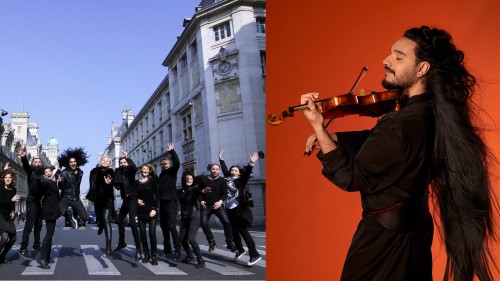
Nemanja Radulović & Double Sens
FRI NOV 13 8PM
NEC's Jordan Hall
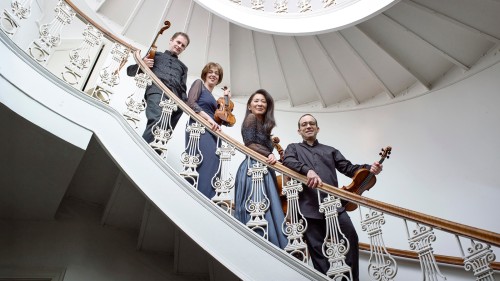
MARK STEINBERG violin
SERENA CANIN violin
MISHA AMORY viola
NINA LEE cello
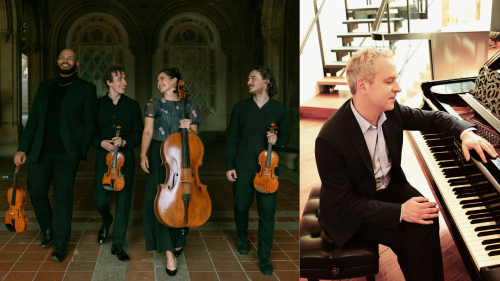
The Brentano Quartet—fearless, spellbinding players whose attention to detail and to each
other give their music freshness and life—bring us "Flights of Fugue," a program that exposes
the unflinching heart of late quartets by Shostakovich and Beethoven. Paired arrangements of
piano works that mirror each other across the centuries set a deceptively orderly tonal roadmap
for the flights of passion and intensity that follow. Both quartets strain the boundaries of the
form: massive in scale and throwing expectations about tempo and mood aside, they are
revelatory, showcasing the unity, vivid intelligence, and ensemble playing that set the Brentanos
apart.
“Make no mistake: the Brentanos are a magnificent string quartet. This was wonderful, selfless music-making.”
The Times (London)
(arranged for quartet)
Like many Soviet artists, Shostakovich had a volatile relationship with the Communist government. In the two decades before Stalin’s death, Shostakovich was lauded as the great hope of Soviet opera; celebrated and subsequently condemned for his opera Lady Macbeth of the Mtsensk District; hailed as a patriotic hero for the “Leningrad” Symphony; condemned again, this time in the infamous Zhdanov Decree of 1948; awarded money, a country home, and two Stalin Prizes; and sent abroad as a cultural ambassador. One of these trips took him to Leipzig, where he served as a judge in a Bach bicentennial festival. A performance of Bach’s Well-Tempered Clavier inspired Shostakovich to compose his own set of preludes and fugues.
Shostakovich completed the cycle, his largest work for solo piano, in February 1951. A month later he performed half of it before a large audience of the Soviet Composers’ Union. The cultural repression of the period was on full display: “We must decisively warn Shostakovich,” an official admonished after the performance, “and all those other composers who have not yet broken with all traces of the modernistic past from indulging in these extremely undesirable relapses.”
Shostakovich casts the E-flat minor fugue as a lilting dance. Its tonality is ambivalent even to the end, when the piece abruptly closes in whisper-soft open octaves. This quiet, uncertain conclusion echoes the final lines of T. S. Eliot’s 1925 poem “The Hollow Men”: “This is the way the world ends / Not with a bang but a whimper.”
© Andrew McIntyre, 2026
Dmitri Shostakovich (1906-1975)
This is Shostakovich's last string quartet, composed in 1974.
Elegy – Adagio, attacca
Serenade – Adagio , attacca
Intermezzo – Adagio, attacca
Nocturne – Adagio, attacca
Funeral March – Adagio molto, attacca
Epilogue – Adagio
Six movements performed attacca (without pause)
Average duration: 37 minutes
Common perception of Shostakovich’s music is deeply rooted in the external, in the relationship of his art to the asphyxiating political climate in which he had to survive. Without a doubt, irony and bitterness in response to the repression of Stalinist Russia inform the music. Yet so much of the response to calamity and pain winds up being an external reflection of internal states common to all mankind: anger, fear, mistrust, caution, alienation. Because of this we find that a great artist such as Shostakovich, even if he may write in response to his immediate personal situation, creates music which is also universal, which touches and moves us through an empathy born of our common knowledge of suffering.
The Fifteenth Quartet, Shostakovich’s final work in this form, comes from the end of his life and takes on the quality of a personal requiem. A glance at the movement titles (including, among others, an Elegy and a Funeral March) immediately suggests such an idea. The composer’s final period postdates Stalin’s death and thus the music is in a sense freed to focus inward at long last. The work is in six connected slow movements, reminiscent of Haydn’s Seven Last Words of Christ, which is similarly meditative in spirit. However, whereas the Haydn work deals with suffering as a source of eventual redemption, this bleaker work offers only a blossoming of doubt as it nears its conclusion.
The opening Elegy has the severity of an etching rather than the opulence of a painting. Spare and cold, one hears here the traditional chanting of the Russian Orthodox church, intoned more than sung. This is mourning without self-pity, a sense of loss that is ancient and eternal. The length and monotony of the movement oppress us with a Chekhovian ennui.
When the music progresses at long last to the Serenade we may expect the change to bring with it a sense of relief, of lightening. Yet whatever more casual song may be yearning to be heard, it is utterly obscured by twelve throat-tearing screams, such as might escape the mouths of figures in Picasso’s Guernica. When a waltz-tune does arrive, its accompaniment is mechanistic and inhuman; so often in Shostakovich we are made aware of the brutality of an uncaring response to heartfelt wishes.
The following Intermezzo picks up on the idea of a painful dichotomy between utterance and response and takes it to its extreme. A wild cadenza for the first violin, almost rent asunder by its own turbulence, is met by frigid indifference in the cello. It is a powerful juxtaposition, perhaps the sense of the individual not understood by society, perhaps the extreme tension between what is felt and what it is safe to express. The well-known words of Dylan Thomas come to mind here: “Do not go gentle into that good night / Rage, rage against the dying of the light.”
The ensuing Nocturne gives a relative sense of crepuscular serenity, featuring a haunting viola theme adorned with glistening spider-web-like arpeggios. Still, there is unease beneath the surface, an inability to release into the potential calm. Perhaps this is a nocturnal rest such as is invoked in Chekhov’s story "Sleepy," where a sleep-deprived nanny finally experiences restorative slumber after strangling the screaming infant in her care.
Announcing a movement together for the first time in the piece, all four instruments proclaim a heavy dotted rhythm at the start of the Funeral March. These statements alternate with individual recitatives which build toward a sense of wailing. If this were a film, these interspersed meditations might be portrayed as internal emotional experiences of the pallbearers, alternating and contrasting with the solemn, inevitable procession.
The Epilogue bursts out with a passage which is an expansion, even an explosion of a trill. This trill becomes the major player in this final movement, used as an obfuscating veil. There are many glances backward, reminiscences of the Elegy and the Funeral March, yet they are enshrouded in a fog of trills. This is an anti-cathartic piece. Whatever solace, whatever certainty may have been felt in the chanting of the Elegy and in the inexorable tread of the Funeral March is now infected with doubt and trembling.
Among Shostakovich’s never-to-be-fulfilled projects were plans for an opera on Gogol’s tale "The Portrait." At the conclusion of this story a man reveals to the crowd gathered at an auction that he must destroy the painting on display. It is a diabolical portrait painted by his father, bringing torment and misery to all who own it; his father has exhorted him to eradicate the painting at all costs. As the man, nearing the conclusion of his tale, turns to gaze upon the painting again he sees that it has been stolen. Here, too, in Shostakovich’s final quartet we are left feeling our chance to face the mysteries revealed has been thwarted. Any hope of resolution is stolen away; all is emptiness.
© 2005, Mark Steinberg
from The Well-Tempered Clavier, Book I (arranged for string quartet by Nicholas Kitchen)
Average duration: three minutes
During his years-long tenure serving the court of Duke Ernest Augustus I, Bach repeatedly attempted to resign. Eventually the exasperated duke had him arrested and jailed for “obstinacy.” Upon release from his month-long incarceration, Bach again submitted his resignation, which the duke, at last, accepted. Years later, one of Bach’s students wrote that he conceived The Well-Tempered Clavier “in a place where ennui, boredom, and the absence of any kind of musical instrument forced him to resort to this pastime.” This remark has led to speculation that Bach may have composed some of the pieces in his head while imprisoned.
The Well-Tempered Clavier includes paired preludes and fugues in every major and minor key. Beginning with a prelude in C major, Bach moves up the chromatic scale, alternating between major and minor (i.e. C major-C minor-C-sharp major-C-sharp minor, etc.) until concluding with a B-minor fugue. Nineteenth-century musicologist Hugo Riemann referred to the C-sharp minor prelude and fugue from Book I as the “holy of holies;” the fugue he compared to a “mighty cathedral.” The five-voiced fugue is one of Bach’s longest and densest. It opens with a dissonant ascending interval which pervades the entire piece. This opening motif returns at least two dozen times, intrusive as a splinter in the mind.
Collections of pieces in multiple key signatures were en vogue at the turn of the eighteenth century. One crucial precursor to The Well-Tempered Clavier was a collection by Johann Caspar Ferdinand Fischer titled Ariadne musica (1702). Its title references the princess from Greek mythology who helped Theseus escape the labyrinth; here, the labyrinth represents the winding journey through the various keys. Fischer used nineteen keys in Ariadne musica. Not to be outdone, Bach became the first known composer to release a collection of fully realized pieces for keyboard in all twenty-four keys. Twenty years later, he completed a second set of preludes and fugues in every key, Book II of The Well-Tempered Clavier (pianists refer to both books collectively as “the 48”).
© Andrew McIntyre, 2026
Adagio ma non troppo e molto espressivo
Allegro molto vivace
Allegro moderato (recitative)
Andante ma non troppo e molto cantabile
Presto
Adagio quasi un poco andante
Allegro
Average duration: 39 minutes
Seven movements performed attacca (without pause)
Beethoven's last published string quartet
Note from Mark Steinberg, violinist in the Brentano String Quartet:
I saw recently a striking illustration by William Blake. A woman in flowing robes with arms extended reaches and glances upwards, floating, suspended in air, yet is shackled by her ankle to the ground. She is the personification of the soul, reaching toward heaven whilst tied to the earth. It seemed to me a perfect visual manifestation of the opening figure of Beethoven’s C-sharp minor string quartet, Op. 131, which despite an upward stretch finds itself forcefully pulled back down, a moment marked by almost suffocating heaviness.
It is an extraordinary theme, starting what is an extraordinary movement by any measure. Of all Beethoven’s works, this is the only one to begin with a fugue, a rhetorical construction evoking the rigors of formal debate. In its weaving together of four voices all declaiming the same prophecy it conjures the sense of the chorus in a Greek tragedy. If this movement is indeed, as Wagner wrote, “the most melancholy sentiment ever expressed in music,” perhaps it is a sadness born of the burden of prophecy In his novel The Story of Forgetting, Stefan Merill Block writes, “Could there be anything more sad and more lonely than remembering what terrible things the future will bring?” In this quartet in C-sharp minor only this opening movement and the final, seventh, section are in that key. Yet the gravity of this fugue makes it seem the vantage point from which all else will be seen, against which all else will be judged, and to which, there is never any doubt, we will be compelled to return.
In its short denouement from a wrenching climax reminiscent of the "Heiliger Dankgesang" of Beethoven’s Op. 132 (written earlier despite its opus number), the movement comes to rest, or rather to hover on a rising C-sharp octave, hollowed of all passion. Now we have the first transformative portal of the piece, for this is a work in seven sections, each connected to the last through some reconfiguring of the imagination. Here Beethoven takes that C-sharp octave and simply, gently lifts it up a minor second, to D. In so doing he trades a key with little natural resonance in a string quartet (due to tuning and natural overtones) for one that rings freely. Light is admitted and dance enters with it, albeit with hesitations and interruptions. And having experienced the distance traversed in finding this place we can appreciate that this alternate world, one where we can participate in life and see the reflection of the heavens above in our worldly joys, was right next door all along. It is no accident that this D is also the uppermost pitch of the cataclysmic chords at the climax of the first movement. This joy is real and vital, but is also a temptation which Beethoven feels we must ultimately relinquish in order to discover our true strength and dignity, as we will see at the close of the work.
The brief recitative section that follows is a formal pointing device, pulling us outside the work. Reminiscent of the oracular feel of the opening fugue, it also serves to refocus our attention on the set of variations to follow, the intimate heart of the work.
The theme of these variations is vulnerable and weightless, split between the two violins. This way of writing, in hocket, contrasts extremely with the opening of the piece, also shared by the violins. There each offers a full revelation, a fait accompli, but now there is an ongoing sense of discovery, the gentlest possible game of tag. (And games galore will take over the piece soon enough.) The very first downbeat of the movement is silent; the subsequent ones are lightened just where the music would naturally be heaviest so that the theme levitates. This is a pattern already set in the previous recitative, but here the missing weight, rather than lending its emphasis elsewhere, evaporates completely. The variations take many forms, sometimes ornate and fanciful, but often tending toward comedy or farce, almost as if avoiding the embarrassment of turning sentimental. Eventually, just after a variation featuring bucolic open drones, left off in mid-thought, our gaze is lifted anew toward the heavens and the stillpoint of the piece is reached. The music is distilled to the merest sotto voce oscillation, and it is as if the faintest breath, the subtlest zephyr were somehow touching the very core of who we are. Poet Albert Goldbarth writes, “There have been nights, admit it, when you’ve thought you heard your name in the air, your name being sung, a recognition that you’re a part of the star-resplendent sky and the musty vapors of earth—they know who you are, you owe them for this special focus.” Strangely, as this music unfolds, intimate and luminescent, disruptions begin infiltrating the texture. As in the Blake image there is something pulling us away, disallowing absorption into the beyond. This adamant refusal to dissolve into the empyrean will appear several more times in the piece and is perhaps what gives the piece as a whole its strength. There are remarkable transformations still to come, with cadenzas, the theme becoming anxious and stuck only to erupt in glittering trills and burbling cello figuration, but it all evaporates in the end, weightless again, slipping through our fingers.
We are not meant to dwell on this for long, as the cello breaks the silence with a brusquely teasing figure. This four-note motif gives birth to a scherzo that now celebrates not the supernal but rather the embodied joy of play, the naive games that seem to be common to all cultures. Here we have the lofty Beethoven playing peek-a-boo, catch, and tag and enjoying fake-outs and silly voices. The movement ends with an eruption of delight that is immediately reinterpreted on a new pitch, a forceful turning of the head to regard more weighty issues we have ignored long enough.
The sixth section has sometimes been seen as an introduction to the final movement, but while it is in a key that will lead us directly back, at long last, to C-sharp minor it is in no way an emotional preparation. The material in this short movement might easily blossom into a 20-minute slow movement in some late Romantic symphony. The depth of yearning, the straining upward and long, mournful sighing downward all make it seem the apotheosis of Romanticism and individual subjectivity. As wrenchingly beautiful as it is, though, its primary meaning in this piece seems to be as something truncated, something to be denied and cast aside.
And thus, it is, in a brutal manner with a collapse of the lush, widespread texture into a single unison C sharp. It is as if we have now passed the event horizon of the home key and are inexorably pulled back with no further real possibility of escape. There is a strength and a defiance to the writing which seem an insistence on Beethoven’s part that despite our frailty and foibles there is a dignity in humanity and in our capacity to create meaning that holds its own against the temptations of other worlds. It is an assertion of the primacy of the will. The next theme to appear makes sense of the entire journey, for it is both a return and a transformation. Instantly recognizable as a version of the fugue theme that opens the work, sharing its exact rhythm with its pitches slightly shuffled so as to lean toward noble resignation rather than striving, its arrival brings a sense of inevitability. What the chorus has proclaimed at the start has come to pass; Fate has seen to that necessity. There are evocations of the beyond again in the second theme of the movement, a radiant cascading scale figure followed by a huge leap upward, and in fluttering upward scales in D major, a reminder of the second movement, but these cannot divert the course of the piece from its preordained path.
Many have found the sudden turn to C-sharp major in the last moments of the piece puzzling, as it is too abrupt and short to convey a change of heart and truly establish the major mode (although it has been explored earlier in the movement). It is known from Beethoven’s sketches that he was originally planning a further transformation, a softening of the opening theme into major, an idea that eventually found its full flowering in the sublime slow movement of the F-major quartet, Op. 135. That movement seems the epitome of consolation and peace. Here Beethoven, rather than aiming for consolation, shows only the reflection of the heavens in the eyes of the man whose feet are firmly planted on the earth, strong and proud in his humanity, holding an equally vast universe within.
© 2009, Mark Steinberg
An interesting article on the work: 26 reasons to adore Beethoven's Op. 131 quartet

Brentano String Quartet | Haydn String Quartet in B minor Op. 64 No. 2
Mozart's Clarinet Concerto
Piano
Anything But Standard: The Music of Ella Fitzgerald and Oscar Peterson