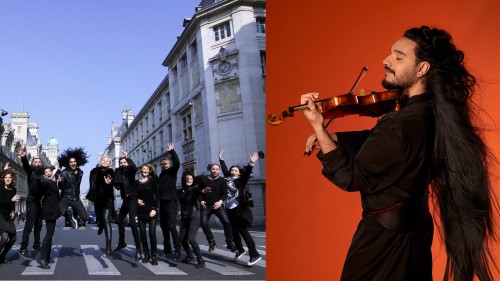
Nemanja Radulović & Double Sens
New program: Beethoven's "Kreutzer" Sonata and Bach
FRI NOV 13 8PM
NEC's Jordan Hall

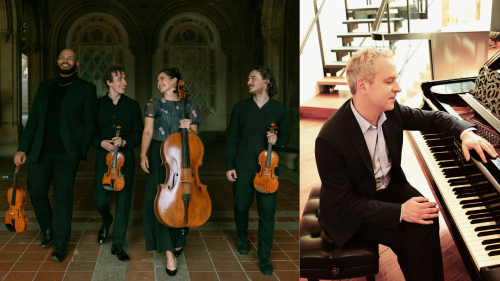
Dover Quartet
JOEL LINK violin
BRYAN LEE violin
JULIANNE LEE viola
CAMDEN SHAW cello
ADAM BARNETT-HART violin
to replace violinist Joel Link for this engagement while Mr. Link takes a temporary break from all performances to recover from a pinched nerve
In their most recent appearance at Jordan Hall, the Dover Quartet won the hearts and souls of audiences for their refined, luminous playing and insightful programming. Pairing subtle gestures with technically brilliant flourishes, they'll capture your attention and leave you utterly spellbound.
Their program features Brahms' final (and favorite) string quartet, Dvořák's nod to Viennese compositional trends while asserting his Czech roots, and an orchestration of Indigenous singer-songwriter Pura Fé's Rattle Songs by Chickasaw composer Jerod Impichchaachaaha' Tate.
Violinist Adam Barnett-Hart steps in for violinist Joel Link due to injury. He is a founding member of the Escher String Quartet, an ensemble celebrated for its profound musical insight and rare tonal beauty. A former BBC New Generation Artist and recipient of the Avery Fisher Career Grant, the quartet performs regularly at Wigmore Hall and the BBC Proms and serves as season artists of the Chamber Music Society of Lincoln Center in New York.
“Named one of the greatest string quartets of the last 100 years.”
BBC Music Magazine
Vivace
Andante
Agitato (Allegretto non troppo)
Poco Allegretto con Variazioni
Brahms felt such reverence for Beethoven that it could be crippling, especially in two of his hero’s signature genres: symphonies and string quartets. Brahms broke through his hesitancy around quartets first, releasing two as a pair in 1873, after eight years of work, and in the wake of many earlier efforts that he destroyed. Having slain that ghost, the next quartet was a much happier affair, composed during Brahms’ 1875 summer vacation in a charming German town nestled between a river and forests. He published it the next year with a dedication to a noted scientist (and amateur cellist) who hosted him during a visit to the college town of Utrecht. In a letter to the dedicatee, he joked, “This quartet rather resembles your wife—very dainty, but brilliant!”
The quartet may not have the gravitas of the First Symphony that Brahms was slogging through in the same period, but it is hardly “dainty,” starting with a first movement that shows off Brahms’ sleight-of-hand with contrasting meters, shifting effortlessly between a triple meter (i.e. each beat subdivided into three parts) for the main theme and a duple meter (with beats subdivided into two) for the contrasting theme. With its singing melody set over a pulsing accompaniment, the second movement Andante updates the spirit of a Mozart slow movement. The agitated third movement shines a spotlight on the viola’s melody by having the three other instruments play with mutes. The finale takes the form of a theme with variations, building to a conclusion that cleverly incorporates the first movement’s theme.
© 2026 Aaron Grad
Average duration: 34 minutes
Pura Fé was the driving force behind the all-female a cappella trio Ulali, which released the groundbreaking album Mahk Jchi in 1994, showcasing a range of Indigenous vocal styles. Born in New York City and raised as a theater kid who sang and danced in Broadway shows, she embraced the legacy of her mother’s roots in the Tuscarora people from North Carolina, and the many generations of female singers that had preceded them in their family. As a solo recording artist and activist, and most recently as a member of the multicultural collective Silkroad, Fé continues to use her voice as a vehicle for social change.
This version of Rattle Songs was arranged for the Dover Quartet by Jerod Impichchaachaaha' Tate, a member of the Chickasaw nation in Oklahoma who creates classical compositions rooted in Indigenous traditions. He experienced Ulali’s breakthrough album as “a unique work of genius, where Native songs are modernized through innovative arrangements and stunningly rich harmonies,” he explained in the liner notes for the Dover Quartet’s recent album, Woodland Songs. “Their work had a powerfully deep impact on my personal vision as a Native composer and I am privileged that they are my friends.”
“Chickasaw music is based in turtle shell shaking,” he continued, “as is our percussion for stomp dancing and social songs. The Tuscarora people share a very similar shell-shaking tradition, as do most Native woodland tribes. In Rattle Songs, Ulali brought together songs from different parts of Indian Country and brilliantly couched them in traditional woodland shell-shaking styles. Camden Shaw, cellist of the Dover Quartet, also happens to be a fan of the Mahk Jchi album. Upon his discovery that I have an affinity for Ulali, he asked if I might be interested in orchestrating Rattle Songs for string quartet. My immediate acceptance and enthusiasm could not be overstated. After consulting with Pura Fé, I have created these orchestrations that are classically impressionistic in a post-modern style. I make no deliberate attempt to imitate the exact sound of rattles from the original songs; rather, I have created a new home for them in the string quartet. Pura Fé created Rattle Songs as a homage to her Native North American cousins and it is my hope that my orchestrations create another layer of honoring our people.”
© 2026 Aaron Grad
Average duration: 15 minutes
Allegro
Poco adagio e molto cantabile
Scherzo. Allegro vivo — Trio
Finale. Vivace
After growing up in a small Bohemian village where his father was the butcher and innkeeper, Antonín Dvořák made it to the big city of Prague and was pursuing his dreams as a freelance musician. That might have been as far as he ever got if not for a lucky break: he entered a composer’s competition, and one of the judges turned out to be none other than Brahms, who was impressed enough to convince his own publisher to take on Dvořák. Before long, a set of Slavonic Dances rooted in Czech folk music made him an international star.
Overnight success introduced a new problem for Dvořák: he was getting pigeonholed as a provincial composer of spruced-up folk music, when really he had spent years honing the meticulous craft of composing “pure” music in the Classical lineage centered in Vienna, from Haydn and Beethoven through to Brahms. As a gigging violist himself, Dvořák proved to be especially adept at crafting chamber music with strings, including nine quartets, a quintet and a sextet that all preceded his sudden fame. It was a great honor when a German violinist and quartet leader commissioned Dvořák’s Tenth Quartet, but he specifically requested a “Slavonic” quartet, underscoring the problem.
When a prominent string quartet in Vienna commissioned his next work in the genre in 1881, Dvořák made a purposeful shift away from folk material. He clearly had Beethoven on the brain, judging from the opening phrase that veers away from the home key of C major within a few seconds to inject the instability of C minor, complete with a short-short-short-long rhythmic motive—a nod to Beethoven’s Fifth Symphony in that same key. Dvořák’s command of the traditional sonata-allegro structure never wavers across the movement’s abundant length, and he maintains a Beethoven-like obsession on small motives, with a dash of Brahms in the energy drawn from an ongoing conflict between flowing triplets and the snap of dotted rhythms with their alternating long and short notes.
Another hallmark of Beethoven and Brahms was the art of achieving cohesion across a multi-movement work through subtle thematic relationships; in this case, the rub between triple and duple rhythms persists as a unifying factor, first in the slow movement that uses misaligned rhythms to enhance the textural richness and preserve the independence of the four parts. The Scherzo plays its own games with triplets, dotted rhythms and other time-based tomfoolery, like when the first violin ends a phrase with the three quick notes of a triplet—in this case spelling out a descending triad—and then repeats those same pitches stretched into smooth quarter-notes, flipping our ears into a whole new perspective of tempo.
© 2026 Aaron Grad
Average duration: 35 minutes

Dover Quartet | Dvořák "American" Quartet, Finale
New program: Beethoven's "Kreutzer" Sonata and Bach
Mozart's Clarinet Concerto
Piano
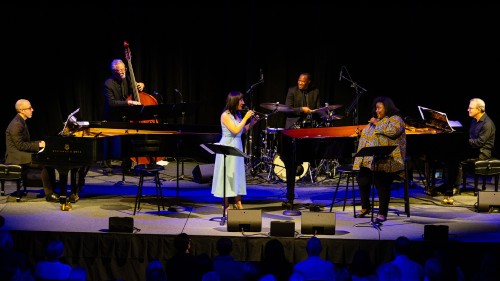
Anything But Standard: The Music of Ella Fitzgerald and Oscar Peterson