Nemanja Radulović & Double Sens
New program: Beethoven's "Kreutzer" Sonata and Bach
FRI NOV 13 8PM
NEC's Jordan Hall
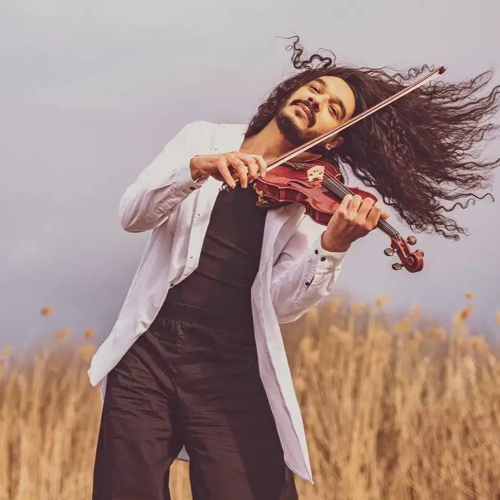
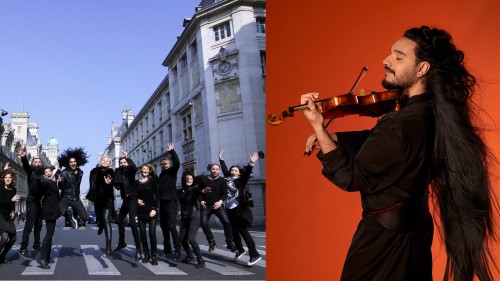
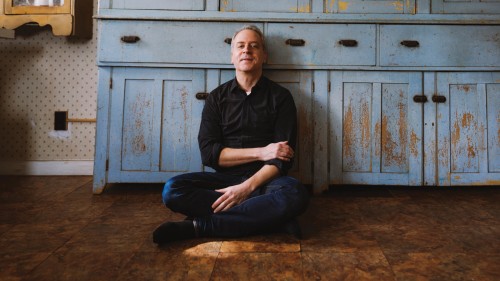
Serbian-born, Paris-based violinist Nemanja Radulović founded Double Sens as an artistic reflection of his dual identity—the creative dialogue between two cultures that shape his voice. He brought together a circle of trusted Serbian and French musicians, united by friendship and a shared desire to inspire one another toward their highest artistry.
Radulović and Double Sens (in the orchestra's US debut tour) bring fresh energy and imagination to works by Beethoven and Bach. At the heart of the program is Beethoven’s Kreutzer Sonata, reimagined by Radulović for violin and orchestra.
Bach's monumental Chaconne from the Partita No. 2 and his Violin Concerto in D minor round out an evening showcasing the ensemble's fiery virtuosity, expressive range, and unmistakable chemistry.
New program! The ensemble will perform a program pairing Radulović's orchestration of Beethoven's "Kreutzer" Sonata with virtuosic Bach masterworks.
Watch Nemanja Radulović in conversation with Vivo Performing Arts CEO Thor Steingraber
“An artist who has the ability to transcend the boundaries of classical music.”
Le Figaro
One 20 minute intermission to follow the Beethoven sonata. Program runs for approximately one hour and 40 minutes, including intermission but not including encores.
I. Adagio sostenuto – Presto
II. Andante con variazioni
III. Presto
Approximate running time: 39 minutes
After starting his professional career as a viola player in his hometown orchestra, the 21-year-old Beethoven (1770-1827) convinced his patron to send him to Vienna to take lessons from Haydn. It was a devastating blow for Beethoven that he missed out on a chance to study with Mozart, his ultimate idol who had died a year earlier, but the silver lining turned out to be that Mozart’s death created an opening for a new hotshot piano player in town. Beethoven stayed on in Vienna and cultivated a thriving freelance career centered around performing, teaching piano lessons, and publishing the kind of sheet music that amateurs would play at home, including sonatas for piano and violin.
Beethoven might have continued on that path indefinitely if not for a devastating change—he was losing his hearing, a condition that left him socially isolated and nearly suicidal by 1802. At the same time, he was formulating new ideas about his approach to composition that would soon allow him to eclipse his teacher-turned-rival Haydn in lofty genres like symphonies and string quartets.
Just before Beethoven began work on the norm-shattering Third Symphony in 1803, he wrote this Violin Sonata No. 9 for a violinist he had been introduced to by an important patron. The violinist, George Bridgetower, had been born in Poland to a Caribbean father of African descent and a European mother, prompting Beethoven to label the score Sonata mulattica in reference to Bridgetower’s mixed racial heritage. They had a falling out before the score was published, and so Beethoven dedicated the score instead to Rodolphe Kreutzer, a French violinist and composer who had visited Vienna in 1798. “Kreutzer” stuck as a nickname, even though Kreutzer himself never played it.
On his manuscript, Beethoven labeled this piece a “grand sonata,” and the first edition of the published score declared it to be written “in a highly concertante style, like a concerto.” Both speak to an approach to chamber music that was a far cry from the simple fare amateurs would play at home, where the violin part was often considered optional and never too challenging; Beethoven was bringing chamber music out of the living room and into the concert hall, and he wasn’t afraid to challenge the performers or audiences.
This larger-than-life sonata has always drawn musicians to expand its footprint, starting with a string quintet arrangement released by Beethoven’s publisher in 1832. This arrangement by Nemanja Radulović brings out the concerto-like qualities by surrounding the violin with a string orchestra, and yet at the same time it maintains the interpersonal intensity of chamber music thanks to the deep rapport among the musicians of the conductorless ensemble Double Sens.
The “Kreutzer” Sonata embraces extremes from the outset, staying in its home key for only four measures of unaccompanied violin before the slow introduction veers to a minor key. Normally the tonal tension would resolve with the arrival of the fast body of the movement—in this case, an extremely fast presto tempo—but instead the instability continues, with the two sections unified by the obsessive gesture of a rising half-step from E to F. Even the presto flow is kept unpredictable, peppered with brief passages that pull back to a slow tempo, recalling the introduction. The consoling second theme does eventually reach the key of A major, but ultimately a coda delivers this fiery first movement back to the crucible of A minor.
In one of Beethoven’s brilliant touches of interconnection, the theme of the slow movement enters with the note F falling a half-step to E, the reverse of the previous movement’s anxious motto. Instead of just decorating the tune, the ensuing variations explore imaginative textures, the sheet music blackened by an uncommon density of notes. For the finale, Beethoven used a Presto movement that he had written and discarded a year earlier while working on a different sonata. The bouncing theme recalls the hunt-inspired momentum of Haydn’s finales, but like everything else in this new phase for Beethoven, the intensity is amplified.
© 2026 Aaron Grad
In 1720, while working a secular job for a music-loving prince in Cöthen, Bach completed a monumental set of six violin solos. He had probably started them more than a decade earlier in Weimar, when he was working as a church organist and rapidly absorbing the latest Italian and French styles that were just permeating Germany. By the time he assembled the Sonatas and Partitas, Bach was in the midst of an extraordinarily productive period for instrumental music, when he also finalized the “Brandenburg” Concertos, the suites for solo cello, the first book of the Well-Tempered Clavier, and many other works intended for public and private entertainment.
The distinction between Sonatas and Partitas has to do with the structure of the movements, the former being modeled on Italian “church” sonatas, and the latter patterned after French dance suites. In the Violin Partita No. 2 in D Minor (BWV 1004), the first four movements conform to the genteel dance traditions of Louis XIV’s France. The final Chaconne, though, is a magnificent anomaly, with its linked variations forming a towering structure that remains, now and forever, the spiritual zenith of the violin repertoire.
The recurring pattern at the heart of the Chaconne first emerges in the lowest voice, starting on D, then traveling from D to C-sharp, D to B-flat, and finally G to A, at which point the cycle begins anew. This simple material fuels some thirteen minutes of ceaseless development, including a rapturous shift to the major mode.
© 2026 Aaron Grad
Approximate running time: 13 minutes
I. Allegro
II. Adagio
III. Allegro
Considering that anyone in the German region of Thuringia in the late 1600s would have known that the name Bach was synonymous with church musician, it was a momentous day in 1723 when the family’s most gifted progeny completed his climb from journeyman church organist to the head of church music for the city of Leipzig, a prestigious post that he held for the rest of his life. Despite the crushing workload of writing music for the city’s principal churches and training the young choristers who would sing it, Bach still found time to direct the Collegium Musicum, an amateur ensemble that gave him a place to let off steam and experiment with secular music not fit for church.
To generate enough repertoire for the concerts that occurred most weeks at Zimmerman’s Coffeehouse, Bach mined his catalog of old compositions, including concertos from Weimar and Cöthen that he recast to feature the abundantly talented harpsichord players in the ensemble—his own sons. One of those works became the Keyboard Concerto in D Minor (BWV 1052), and although the earlier concerto that Bach transcribed it from never surfaced, it was an easy guess that that the original soloist was a violin, considering that it stays precisely within the violin’s range of pitches, and leans heavily on patterns that repeat the notes G, D, A and E, the violin’s open strings. Bach liked the source material enough that he had already adapted movements into two different cantatas in Leipzig, and his son Emanuel even made his own keyboard concerto version that predated his father’s. This performance features a reconstruction of the lost violin concerto, which can be triangulated with reasonable certainty by referencing its various offspring.
When Bach began writing violin concertos, he was integrating the lessons he learnd from the international titan of the genre, Antonio Vivaldi. The first movement’s unison declamation is a classic Vivaldi formula, but Bach’s own genius for shaping a single line of music takes it to a different level, with six tense measures that withhold the harmonic resolution through a series of increasingly wide and reckless leaps. When the awaited tonic chord finally arrives, the soloist launches into ornate figurations. This collision of materials plays out with incredible drama in the ensuing ritornello form, which separates returns of the main theme (in various keys) with fluid solo episodes.
The Adagio movement also begins in unison, tracing a line full of inner dialogue and heavy emotion. The violin enters with a voice-like melody that continues to spin serpentine phrases over the ensemble’s plodding bass line until reaching a solemn ending that returns to a dry unison texture. The Allegro finale once more uses Vivaldi’s device of a unison entrance, but this one splits off quickly into lively counterpoint with a highly active bass line. The solo episodes that exploit rapid string crossings and other idiomatic violin tricks leave no doubt that this was how Bach originally conceived it.
© 2026 Aaron Grad
Approximate running time: 22 minutes
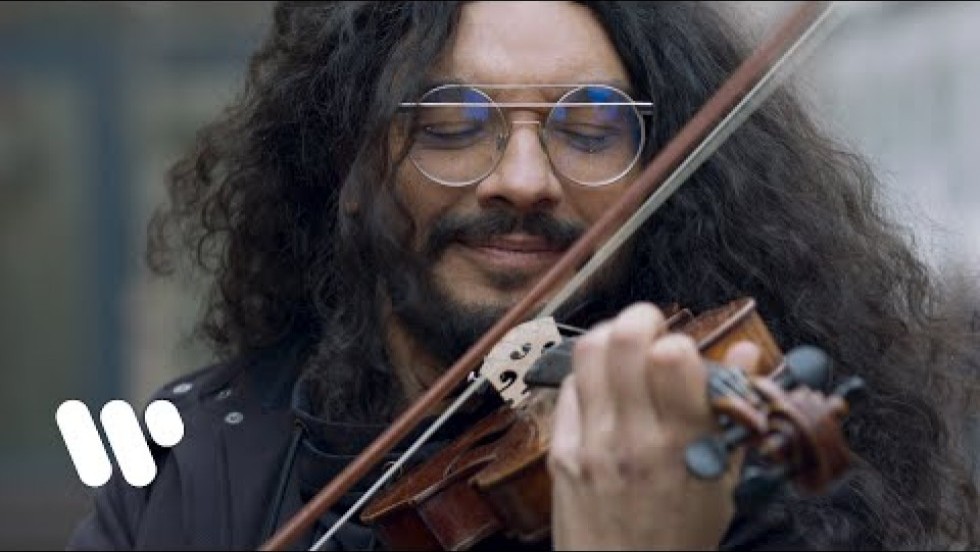
Nemanja Radulović & Double Sens | Hommage à Aleksandar Šišić (Medley)
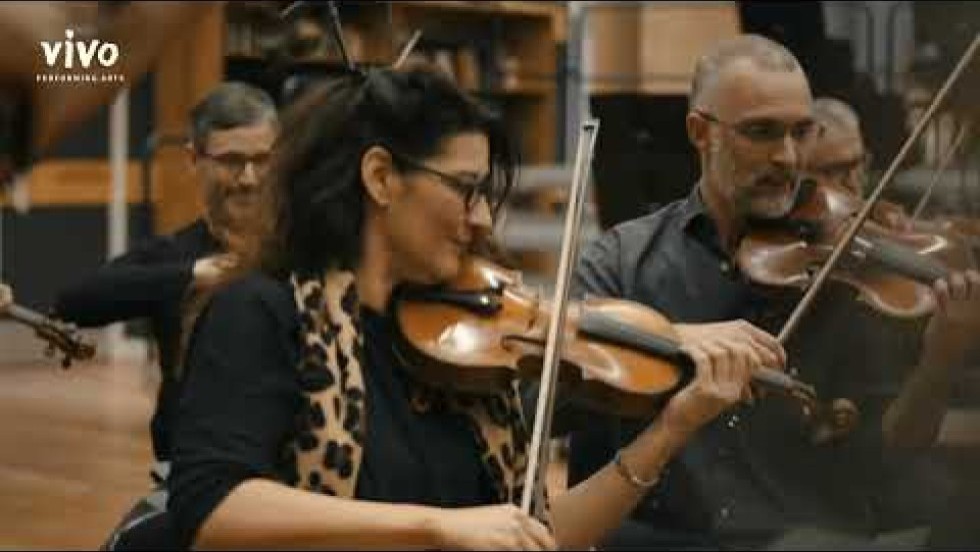
Nemanja Radulović and Double Sens: Bach Preview
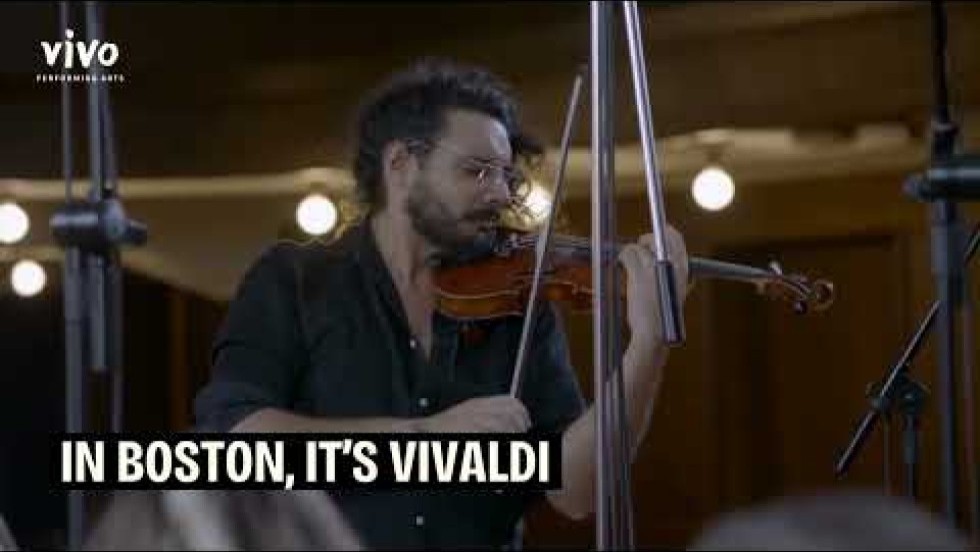
Nemanja Radulović and Double Sens: Beethoven Preview
New program: Beethoven's "Kreutzer" Sonata and Bach
Mozart's Clarinet Concerto
Piano
Anything But Standard: The Music of Ella Fitzgerald and Oscar Peterson