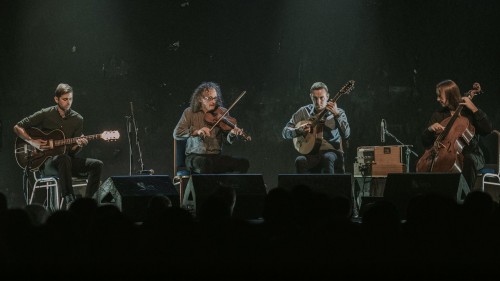
A St. Patrick's Day Irish Celebration
Curated by Martin Hayes, with the Common Ground Ensemble and Special Guests
WED MAR 18 8PM
Symphony Hall
Gerhild Romberger mezzo-soprano
Boston Lyric Opera Chorus, Brett Hodgdon director
Boys of the St. Paul’s Choir School, Brandon Straub music director
Get ready for an evening of music that holds nothing back. Mahler’s Third Symphony is a colossal masterpiece, featuring two choirs, an expanded orchestra, and an alto soloist. The epic work embraces the forces of nature, the exuberance of life, the innocence of childhood, and the transcendent beauty of love.
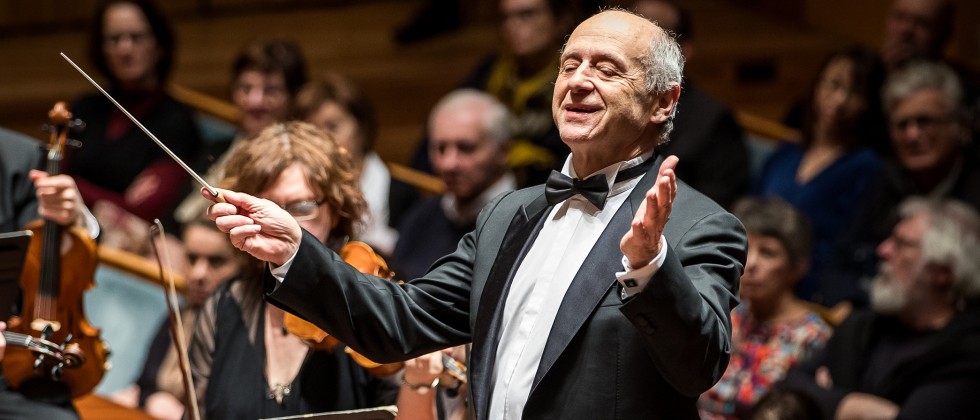
Leading this journey is the acclaimed Mahler interpreter Iván Fischer and his Budapest Festival Orchestra. With their signature humanity, clarity, and attention to detail, they bring this symphony to life—capturing the rustle of birds and insects in a summer meadow, the shimmer of moonlight, and the breathtaking sweep of the triumphant finale.
Presented in association with Boston Lyric Opera
“Difficult to imagine the avowedly summery third and its distanced solos being bettered any time soon.”
Gramophone
“One is only an instrument played by the universe. A symphony must be like the world. It must embrace everything,” said Mahler, and this closeness to nature seems most manifest in his Symphony No. 3.
The last time that the longest symphony in the history of music was performed by Mahler specialist Iván Fischer and the Budapest Festival Orchestra was ten years ago. On that occasion, the solo of the six-movement philosophical composition was sung by mezzo-soprano Gerhild Romberger, who has a history with this orchestra of embodying the heroine of the piece’s “human” movement and will join us again today. The angels will be sung by the chorus of Boston Lyric Opera and the boys of the St. Paul’s Choir School in Cambridge.
During the six years he spent in Hamburg, Mahler composed two important symphonies. Unlike the Second Symphony entitled “Resurrection,” the Third has no title in its score, even though the composer added notes to the whole composition and each movement. Eventually, however, he decided not to influence the fantasy of audiences so strongly. Still, we can learn from the titles, and they reveal a lot about the literary and philosophical influences and messages that he was interested in at the time.
The piece was entitled “A Summer's Midday Dream”; however, Mahler immediately dispelled the idea of comparing it to a "Midsummer Night’s Dream": “Not after Shakespeare. Critics and Shakespeare scholars please note.” The words "summer," "midday," and "dream" can be linked to Nietzsche’s philosophical novel, Thus Spake Zarathustra, and indeed, in the fourth movement of the symphony, an excerpt of its text is set to music. The subtitle, “My Joyous Science,” further confirms this connection, as it is a clear reference to Nietzsche’s work.
The six movements of “A Summer's Midday Dream” are divided into two major parts. The first one is the extensive opening movement with a slow introduction (Pan’s Awakening). As in his first two symphonies, Mahler has incorporated into the composition an earlier song, this time the “Changing of the Guard in Summer.” ("The Heavenly Life,” originally intended for the finale eventually became the closing movement of Symphony No. 4.) The only movement in the symphony telling a mythological story was entitled “Summer Marches in (Procession of Bacchus)” conjuring up Pan awakening from his sleep, the herald and the battle of the seasons. After this, the composer prescribed a longer pause before the other movements, which are rather different in character.
The minuet beginning the second part (“What the Flowers in the Meadow Tell Me”) almost takes us back to the world of Haydn’s symphonies. It is followed by a scherzo (“What the Animals in the Forest Tell Me”), which “seems as if all of nature was making faces and sticking out its tongue.” Ascending on the Schopenhauerian steps of ideas, the hero of the fourth movement is “Man.” At this point, Mahler relies on human voice for a song based on Nietzsche's words of profundity, anguish, bliss, and eternity. For the angels’ song in the fifth movement, he turned to a poem from the folk poetry cycle “The Youth's Magic Horn” (Des Knaben Wunderhorn), which he had often used before. In this movement transcending human reality, the music brightens into a major key for the first time. The symphony concludes with a grand slow movement telling us of the love of God, because "in an adagio everything dissolves in stillness; whereas, in the fast movements everything flows, moves and changes."
-Note provided by the Budapest Festival Orchestra
Curated by Martin Hayes, with the Common Ground Ensemble and Special Guests