Danish String Quartet
FRI FEB 27 8PM
NEC's Jordan Hall
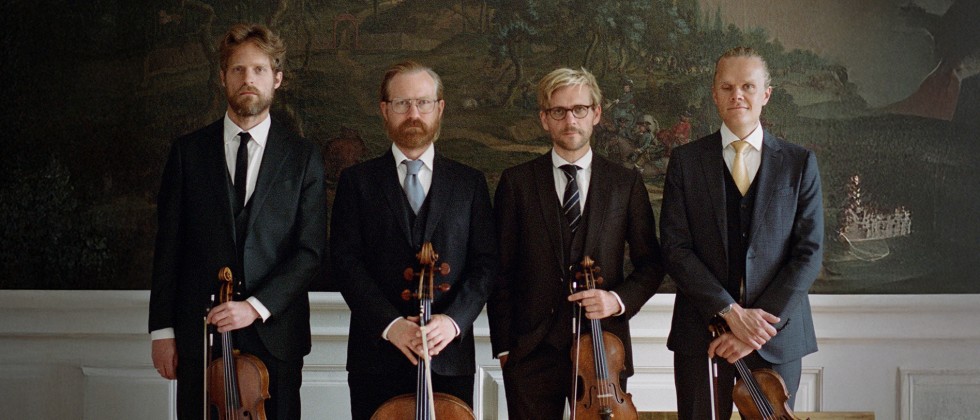
Frederik Øland & Rune Tonsgaard Sørensen violins
Asbjørn Nørgaard viola
Fredrik Schøyen Sjölin cello
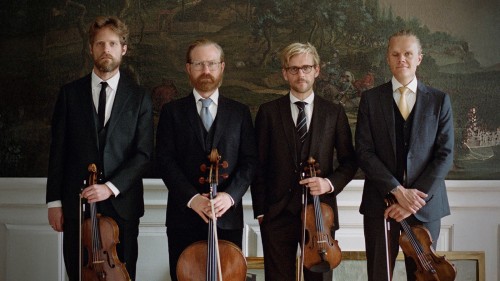
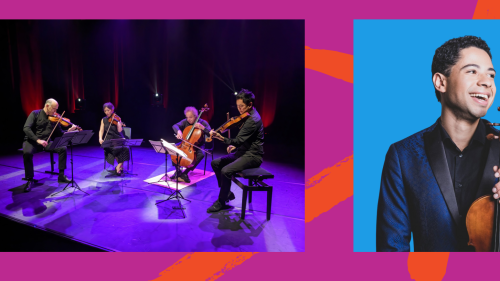
It’s always a pleasure to welcome the Danish String Quartet to our stages. Over three previous appearances, they have captivated audiences with thoughtfully curated programs, peerless ensemble playing, and the unmistakable warmth and camaraderie that come from more than two decades of performing together.
The self-described “three Danes and one Norwegian cellist” return with a program that shows their admirable range. Postmodern Soviet composer Alfred Schnittke’s String Quartet No. 2 paints a sorrowful picture of grief and mourning while offering moments of intensity and virtuosity. Jonny Greenwood’s five-movement suite from the film There Will be Blood brings an atmospheric edge to the program. His foreboding, intricately textured score features “leaping, fiendish” (Pitchfork) writing for cello, making it a striking addition to the quartet’s repertoire. Ravel’s only string quartet closes the program, offering a moment of lyrical and subdued beauty from this extraordinary ensemble.
“So what is it about them that prompts such acclaim? …For my part, I’ve got to give it to two things: their commitment to connecting and contextualizing music from all areas of the concert music tradition and beyond, and the unbridled joy they take in playing with one another.”
The Boston Globe
The Russian composer Alfred Schnittke received his earliest musical training in Vienna, while his father served there as a translator. After graduating from the Moscow Conservatory in 1958, he made waves with the explosive oratorio Nagasaki, and despite receiving an official rebuke from the government-aligned Union of Composers, he managed to sustain a career by scoring state-sponsored films and teaching. In his original music, he navigated the constraints on Soviet composers by honing a “polystylistic” sound that borrowed freely from music of just about any style and era, from the holiest church music to the bawdiest songs.
Schnittke composed the String Quartet No. 2 in 1980 as a memorial tribute to Larissa Schepitko, a filmmaker and friend who had recently died in a car accident at the age of 41. “Her death was a hard blow for me,” Schnittke wrote, “as it was for everyone who knew her.” Keeping with his tendency to engage with pre-existing music, he infused this emotionally wrenching quartet with Russian Orthodox chant, noting that “Russian church music of the 16th-17th centuries was quite peculiar thanks to its dissonant heterophony.”
© 2026, Aaron Grad
Growing up in Oxford, England, Jonny Greenwood played recorder in Baroque ensembles and viola in a student orchestra. He taught himself guitar and keyboards to play in a band with his older brother and other local musicians, and that band—Radiohead—blasted onto the alternative rock scene with their debut single “Creep,” propelled by the edgy guitar work of the 20-year-old Greenwood.
Radiohead became a global sensation, driven in part by Greenwood’s vast sonic palette that grew to include string sections, synthesizers, and every guitar sound imaginable. He began to develop his own solo career on the side, scoring a documentary for the first time in 2003 and composing his first orchestral works in 2005. He caught the attention of the filmmaker Paul Thomas Anderson, who invited Greenwood to compose the score for There Will Be Blood in 2007, launching one of the great film collaborations of the 21st century. Just as Alfred Hitchcock leaned on Bernard Hermann’s music to ratchet up the psychological tension, Greenwood’s raw and atmospheric scores have become indispensable in Anderson’s expansive films, including his latest, One Battle After Another (which could very well win Greenwood his first Oscar, after two previous nominations).
In 2018, Greenwood arranged portions of the There Will Be Blood soundtrack as a concert suite, in versions for string orchestra and quartet. The most striking departure from concert music conventions comes in the section labeled Detuned Orchestra, which, Greenwood explained in a program note, “requires the lowest string of each instrument to be detuned by approximately one octave. The string should not be too slack, a note should sound when the string is bowed. That note will be of a wavering, unpredictable pitch—this is deliberate! The string should be slack enough that when a note sounds, increasing the bowing pressure makes the pitch rise dramatically.”
© 2026, Aaron Grad
Maurice Ravel, meticulous yet hot-headed, took after both of his parents, a Swiss engineer and a Basque peasant. Even though he was raised in Paris, Ravel was a perennial outsider who got himself expelled from the Paris Conservatory once as a piano student in 1895, and then again in 1900 after he returned as a composer and wouldn’t follow the rules for writing a proper fugue. His five consecutive rejections in the prestigious Rome Prize competition became something of a public scandal, and even his own teacher, Gabriel Fauré, piled on when he labeled Ravel’s final submission “a failure.” The submitted piece was none other than the String Quartet in F Major, which has long since taken its rightful place as a cornerstone of the quartet repertoire.
One musician who recognized the power of Ravel’s quartet was Debussy, who wrote to his younger colleague, “In the name of the gods of music and in my own, do not touch a single note you have written in your Quartet.” Ravel’s quartet in fact shares many traits with Debussy’s own string quartet from a decade earlier, in the way they both develop thematic connections that link the separate movements.
Ravel’s String Quartet opens with a sweet theme from the first violin, split into two balanced phrases—a promising start for a competition entry. It only takes five measures, though, for the harmonies to abandon the home key, while the telltale melody glides over mystical whole-tone sequences and Eastern-tinged minor modes.
A close kin of the opening melody returns as the basis of the second movement, marked “rather lively, very rhythmic.” The plucking textures and modal harmonies transport this scherzo-like statement to the realm of a Flamenco dance, reflecting Ravel’s fascination with his mother’s native Spain.
The central melody of the “very slow” third movement, introduced by the muted viola, is a drawn-out variant of the same unifying theme. The motive returns yet again as a secondary figure in the finale, but first the quartet presents music that lives up to the “lively and agitated” tempo marking. Having worked through this provocative material, the quartet rises to a bright F-major chord, reaching the conclusive home key in a manner contrary to everything Ravel learned in a classroom.
© 2026, Aaron Grad
Beethoven – String Quartet in A Minor, Op. 132, 3rd movement
This performance is an Aaron Richmond Recital, named in honor of Vivo Performing Arts's founder, and endowed by his daughter Nancy Richmond Winsten and her late husband Dr. Joseph Winsten.
at NEC's Jordan Hall in Boston

Poetry and Fairy Tales
Replacing Joyce Yang, who is unable to perform due to injury