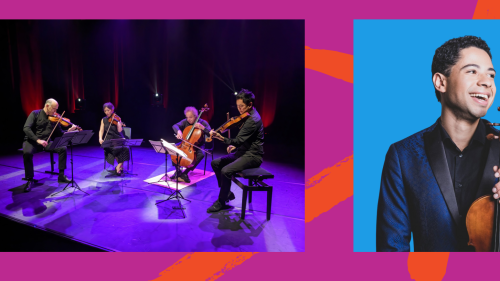
Takács Quartet with Jordan Bak, viola
SAT APR 11 8PM
NEC's Jordan Hall
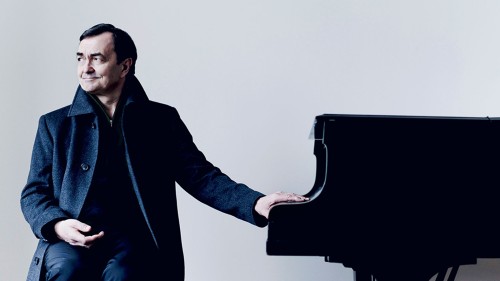
Pierre-Laurent Aimard, one of the world’s most respected pianists, makes a long-anticipated Vivo Performing Arts debut with his signature intellect, expressiveness, and clarity.
“A brilliant musician and an extraordinary visionary,” according to the Wall Street Journal, Aimard is a champion of contemporary music, yet here he tackles a cornerstone of keyboard literature—Bach's Well-Tempered Clavier, Book II—a work that shaped the course of Western music.
Join Aimard for an 88-key journey though the 24 keys of the preludes and fugues, where his insightful interpretation reveals the genius of Bach in thrilling new dimensions.
In Evening in the Palace of Reason, author James Gaines recounts the meeting between Johann Sebastian Bach, late in his life, and the energetic reformer Frederick the Great, King of Prussia. Before pianist Pierre-Laurent Aimard begins his journey through Bach's Well-Tempered Clavier, Volume 2, you're invited to join us for a facilitated online one-hour discussion about the book and related topics. Read part or all of the book selection: it's a jumping-off point for a lively and thought-provoking conversation!
Learn more“Aimard’s gift for contrapuntal transparency is exceptional, and it is hard to imagine anyone performing a fugue with greater focus, achieved by meticulous internal balancing of lines and the texture-clearing techniques of minimal pedalling and neatly chiselled articulation.”
Gramophone
“…Aimard at the apex of his musicianship: technique and imagination at the service of sheer expressive intensity.”
The New York Times
“To listen to Aimard in action is to feel the gears of a composition mesh in new ways. It’s to hear the urgency and beauty in music that might otherwise sound grating or remote. ”
The San Francisco Chronicle
After years serving as court musician to Duke Ernest Augustus I in the German city of Köthen, Bach repeatedly attempted to resign from the post. In response, the exasperated duke had him arrested and jailed for “obstinacy” in 1717. Upon release from his month-long imprisonment, Bach again submitted his resignation, which the duke, at last, accepted. Many years later, one of Bach’s students wrote that he first conceived Das Wohltemperierte Clavier (The Well-Tempered Clavier) “in a place where ennui, boredom, and the absence of any kind of musical instrument forced him to resort to this pastime.” This remark has led to speculation that Bach may have composed some of the pieces in his head while imprisoned.
In Bach’s own words, The Well-Tempered Clavier is a collection of “preludes and fugues through all the tones and semitones, both as regards the tertia major or Ut Re Mi and as concerns the tertia minor or Re Mi Fa.” Simply put, The Well-Tempered Clavier includes paired preludes and fugues in all twelve major keys and all twelve minor keys. Beginning with a prelude in C major, Bach moves up the chromatic scale, alternating between major and minor (i.e. C major-C minor-C# major-C# minor, etc.) until concluding with the B minor fugue.
Collections of keyboard pieces in multiple key signatures were something of a fad at the turn of the eighteenth century. One crucial precursor to The Well-Tempered Clavier was a collection of pipe organ music by Johann Caspar Ferdinand Fischer titled Ariadne musica (1702), a work Bach would have been familiar with. Its title references the princess from Greek mythology who helped Theseus escape the labyrinth; here, the labyrinth is a metaphor for the tortuous journey through the various major and minor keys. Fischer used nineteen of the twenty-four keys in Ariadne musica. Not to be outdone, Bach became the first known composer to release a collection of fully realized pieces for keyboard in all twenty-four keys. Twenty years later, he would complete a second set of preludes and fugues in every key, Book II of The Well-Tempered Clavier (pianists refer to both books collectively as “the 48”).
Unlike his Goldberg Variations in which all of the movements share a common theme, the pieces which make up The Well-Tempered Clavier are united solely by the relationship of their key signatures. Many of the pieces were written before Bach had even begun to conceptualize The Well-Tempered Clavier: nearly half the preludes in Book I were first collected in the Clavier-Büchlein, a set of study pieces Bach had written for his eldest son, Wilhelm Freidemann. While those preludes were transferred over mostly unaltered, Bach transposed some pieces to make them fit into the work’s overall tonal scheme. Other fugues were added later.
Bach compiled Book 2 of The Well-Tempered Clavier sometime in the early 1740s. By that time, he had completed most of his great works such as the Sonatas and Partitas for Solo Violin, the Cello Suites, the Brandenburg Concertos, and the St Matthew Passion. His Goldberg Variations had just been published. Yet he had yet to finish the collection of keyboard pieces he called Musical Offering, he was still at work on the Art of Fugue, and he would complete the Mass in B Minor only in the last few years of his life.
We don’t know what inspired Bach, at least twenty years after compiling the twenty-four preludes and fugues of Book 1, to create a second. His role as Thomaskantor of Leipzig, as well as his other musical activities, kept him busy. He was a father, husband, and teacher alongside his composing duties. As a teacher, Book 2 offered a new pedagogical tool.
In nearly every way, Book 2 is more difficult than its predecessor. Its fugues are longer and more complex, posing greater technical and structural challenges. It contains examples of almost all the keyboard styles and forms available to Bach, including dances both modern and old-fashioned, dramatic ariosos, and brilliant toccatas. He blends the “outdated” techniques of the stile antico (antique style) with popular dance forms of the era, such as the minuet and gavotte. Because of its complexity, Book 2 has long been considered less accessible; as a result, it is under-recorded and underperformed compared to its older sibling.
“Each of the 48 pieces is unique and demands specific interpretative choices,” writes Pierre-Laurent Aimard. “The aim is to generate sound sources that respond to the polyphonic and expressive needs of each piece, and to let them breathe in the right acoustic space. I hope these choices honor the unsurpassed synthesis of styles that gives this monumental work its enduring value as a testament of its time.” The diversity of styles contained within The Well-Tempered Clavier points to Bach’s desire to advertise the breadth of his talents, but at their core these are instructional pieces intended for private use; on the title page of the autograph score of Book I, Bach dedicated the music “For the use and profit of the musical youth desirous of learning as well as the pastime of those already skilled in this study.” He likely would not have dreamed that 300 years after their completion, audiences would sit listening in rapt silence to the second book of his Well-Tempered Clavier in its entirety.
What is “Well-Tempered”?
Bach’s obituary, co-written by his son Carl Philipp Emanuel and a former pupil, recounts several anecdotes about the composer. Alongside anecdotes about his “fair soprano voice” changing as a boy and a victorious keyboard improvisation contest, the penultimate paragraph makes a bold yet enigmatic claim: “In the tuning of harpsichords, he achieved so correct and pure a temperament that all the tonalities sounded pure and agreeable. He knew of no tonalities that, because of pure intonation, one must avoid.” In the ensuing centuries, scholars have debated the meaning of these two sentences and their implication for how Bach’s music (especially The Well-Tempered Clavier) “should” sound.
The history of Western tuning has its origins in ancient Greece with so-called Pythagorean tuning, a system based on pure mathematical ratios (e.g., 2:1 for octaves and 3:2 for perfect fifths). According to legend, Greek mathematician and philosopher Pythagoras (the namesake of the Pythagorean theorem of right triangles) heard the hammering of blacksmiths and realized that the hammers produced different pitches directly proportional to their weights. When struck simultaneously, these hammers purportedly produced pure, consonant harmonies (the four- and eight-pound hammers, for example, would have sounded an octave apart). While philosophers argued for the ease and purity of these “natural” intervals, these interval ratios yield increasingly dissonant harmonies the further one moves from the original pitch (one English composer attributed this dissonance to “the Deity [who] seems to have left music in an unfinished state, to show his inscrutable power”). These unpleasant sonorities necessitated tempering, the slight altering of intervals to create more functional tuning for instruments. In the two millennia separating Pythagoras and Bach, as musical practice changed and new instruments and styles emerged, theorists and musicians advocated various tuning systems to adapt to changing times and tastes.
One of the more popular tuning methods in Bach’s day was known as well temperament, a collection of tunings in which an instrument could be played in every key without sounding out of tune. While other composers had beaten Bach to writing pieces in all twenty-four major and minor keys (plucked string players had been using equal temperament, the tuning favored for concert instruments today, for over a century), he was the first to collect a unified set for the keyboard. This achievement led some to assume that Bach had discovered a new, hitherto-unheard tuning, or perhaps even perfected equal temperament, in which the distance between all semitones is identical. One recent theory even posits that a handwritten scrawl on the original manuscript of The Well-Tempered Clavier points to a secretly-coded tuning method.
What does all this mean for Bach, and how are we supposed to hear his music? While Bach’s contemporaries noted his fastidiousness in tuning his keyboards, none ascribed to him a unique system of tuning. “Well-tempered” referred to a loosely collected group of tuning systems, and the inconsistent use of such phrases make it unlikely Bach intended it to describe an exact method. More likely, Bach’s title broadly refers to “good” or “appropriate” tuning, a temperament that simply sounded pleasing to his and others’ ears.
Posthumous Reception of The Well-Tempered Clavier
Some of Bach’s music was considered quaint even before his death, though he remained well-regarded among musicians even as his music fell further out of fashion with audiences. A beautiful illustration from the late eighteenth century imagines Germany’s great composers as the rays of the sun; J. S. Bach sits at the center of them all. As his obituary notes, many of his works remained unpublished at the time of his death (The Well-Tempered Clavier wasn’t published until the nineteenth century). Some were copied by hand and passed down among Bach’s pupils, children, and other musicians.
In Vienna in 1782, Mozart played Bach’s fugues at the home of Dutch diplomat and arts patron Baron Gottfried van Swieten (Ludwig van Beethoven would do the same two decades later). Instantly taken with these works, Mozart introduced them to his wife-to-be Constanze, who herself became so besotted by Bach’s fugues that she hounded Wolfgang into writing his own fugues as well as arranging pieces from The Well-Tempered Clavier. Less than a year later, an eleven-year-old Beethoven received his first print review, which read in part, “to say everything in a word, he plays most of The Well-Tempered Clavier…. Anyone who knows this collection of preludes and fugues in all the keys (which one could almost call the non plus ultra) will know what that means….” As an adult, Beethoven continued to study Bach, acclaiming him father of harmony and proclaiming, “Not Bach [brook] but Meer [sea] should be his name.” In his late period, Beethoven’s fascination with Bach’s fugues manifested in some of his greatest works such as the Missa solemnis and the late string quartets.
Nearly eighty years after Bach’s death, Felix Mendelssohn launched a revival of his music that continues to this day. In 1829, then twenty-year-old Mendelssohn arranged and conducted the Berlin premiere of Bach’s St. Matthew Passion, a performance that remains a pivotal event in the resurgence of interest in Bach’s music. Following the beginning of this Bach revival, composers as diverse as Robert Schumann and Richard Wagner praised The Well-Tempered Clavier, Schumann calling it a musician’s “daily bread.” In the nineteenth century alone, more than 200 books about Bach were published. Imitative tributes appeared throughout the nineteenth and twentieth centuries. Chopin’s 24 Preludes remain a high-water mark of the genre, combining pedagogy with concert-worthy works of supreme beauty.
In the twentieth century, technological advancements expanded the reach of The Well-Tempered Clavier beyond anything Bach could have imagined. Wendy Carlos’ Switched-On Bach, arrangements of classical compositions performed on synthesizer, sold over a million copies following its release in the late 1960s. Less than a decade after its release, NASA launched two copies of the Voyager Golden Record into space aboard the Voyager probes. These discs contained recordings of sounds and musical compositions representative of humanity, including three compositions by Bach, more than any other composer. Glenn Gould’s recording of the first prelude and fugue, in C major, was included on the record.
© Andrew McIntyre, 2026
Pierre-Laurent Aimard – Bach Trailer
This performance is an Aaron Richmond Recital, named in honor of Vivo Performing Arts's founder, and endowed by his daughter Nancy Richmond Winsten and her late husband Dr. Joseph Winsten.

Replacing Joyce Yang, who is unable to perform due to injury

Presented by Vivo Performing Arts in association with Boston Early Music Festival