
Takács Quartet with Jordan Bak, viola
SAT APR 11 8PM
NEC's Jordan Hall
Edward Dusinberre and Harumi Rhodes violins
Richard O’Neill viola
András Fejér cello
with Jordan Bak viola
The Takács Quartet—long celebrated for their fearlessness, power, and interpretive clarity—finds a well-matched partner in American violist Jordan Bak. Like the Quartet, Bak draws praise for his power and warmth, commanding presence, and ability to captivate an audience’s attention and imagination.
While all five musicians are dedicated champions of contemporary music, they bring their interpretive insights to bear on string quintets by Mozart, a composer whose legacy echoes across history.
The Quartet opens the program with Schubert’s Quartettsatz, a riveting movement filled with turbulence and lyricism. At the heart of the program, hear two relative rarities performed with unparalleled artistry and depth as Jordan Bak joins forces with the inimitable Takács Quartet!
“Bak’s "playing was so constantly involving and impressive that one was drawn to each note and phrase." ”
New York Classical Review
“The Takács are impressive…every micro-phrase, every note is considered. Their sound draws you in from the first moment. ”
Gramophone
Franz Schubert played string quartets with his family as a teenager, and a flurry of novice quartets were among the hundreds of compositions that he created before the people of Vienna had seen or heard a note of his music. After a gap, he began another quartet when he was 23, but he set it aside after completing a very strong first movement and the start of a slow movement. We don’t know exactly why he started it or why he gave up, but in general it was a time that the frustrated young composer was jumping quickly from project to project, chasing dead-end leads and testing new approaches. (His “Unfinished” Symphony met a similar fate two years later, and the list of opera misfires in that period is too long to enumerate.)
The one complete movement of the String Quartet in C minor, known to musicians as the Quartettsatz—German for “Quartet Movement”—only saw the light of day long after Schubert’s death, in an edition that his great admirer Johannes Brahms edited for publication in 1870. This quirky quartet is unsettled and tremulous, both on its surface and within its deeper architecture. The fluttering opening music makes a frightful climb to a bracing, unexpected chord, without ever landing on a real melody in the home key of C minor. The sweetest tune arises in a detour to A-flat major, and then it breaks off suddenly, as if a pleasant daydream snaps back to a harsh reality. For listeners versed in the tidy architecture of sonata-allegro form, this music frustrates all the normal expectations without quite breaking any rules. It took decades for tastes to catch up, but now we rightfully celebrate Schubert’s idiosyncratic genius.
© 2026 Aaron Grad
Mozart took a big chance when he left his hometown of Salzburg in 1781 to try his luck as a freelancer in Vienna, and it paid off—for a while. Capitalizing on his dazzling talents at the keyboard, he gigged constantly, including the self-produced subscription concerts where he premiered many of his new piano concertos and pocketed healthy profits. But then concert life in Vienna cratered amid escalating tensions with the Ottoman Empire (and soon the latest eruption of that intermittent war), and Mozart found himself responsible for feeding a growing family on a dwindling income.
The two new string quintets that Mozart composed in 1787 were intended to help plug that gap, along with a quintet arrangement of an earlier wind serenade. He advertised their upcoming publication in a Vienna newspaper and even borrowed money against his expected earnings, but the publishing fell through, in one of the many dead ends from that trying period.
Mozart had plenty of experience with string quintets, dating back to the one he wrote as a 17-year-old in Salzburg. His choice to include two violas in that fledgling quintet (as opposed to two cellos) followed the lead of Michael Haydn, Joseph’s younger brother and the court Konzertmeister in Salzburg. Mozart returned to the same format in all of his later string quintets, which makes sense given his own predilection for taking the viola part when playing chamber music.
The String Quintet in G minor (K. 516) is in many ways a precursor to the iconic Symphony No. 40 that Mozart wrote the next year in the same stormy key. Starting on the anticipatory upbeat, the upward thrust of an arpeggio launches the main theme of the Allegro with the kind of kinetic energy Mozart picked up years earlier from the famed court composers in Mannheim, Germany; that type of arpeggio was in fact known as the “Mannheim rocket,” and Mozart used another just like it in the finale of the forthcoming symphony. After having the first violin take its usual role of voicing the melody, the next phrase exploits the quintet’s sonic range and moves the theme to viola, supported only by the second viola and cello.
This quintet places its unusually stern and severe Menuetto movement next, characterized by stabbing accents and slippery chromatic passages. Mutes add extra warmth to the slow movement in the consoling key of E-flat major, a contrast that becomes even more stark when the finale enters with its own slow music in a pulsing G minor. That brooding music proves to be a rather substantial introduction to the body of the finale, which dispels the quintet’s tension with chipper, dance-like music in a bouncy triplet meter.
Mozart completed the String Quintet in C Major (K. 516) a month before the G-minor example, and it shows him working through similar ideas about the medium. This quintet also uses rising arpeggios to create propulsive energy, and it also engages in conversational exchanges between voices, this time starting with the first violin and cello in the leading roles. Any expectation that this work in the sunny key of C major might offer unclouded, easy listening is dispelled in the first minute, when the ensemble resumes after a measure of silence by rehashing the main theme in C minor.
Mozart’s manuscript shows the Andante coming next, but early publications swapped the inner movements to have the Menuetto appear first, and it still gets played both ways. In this period when Mozart was fresh off of The Marriage of Figaro and already plotting Don Giovanni, his operatic tendencies really shine through, especially in the mellifluous phrases for violin and viola in the slow movement. In the boisterous finale, one key to the ceaseless forward drive is the counterpoint that tosses motives and fragments among the voices, a skill that Mozart honed in Vienna after a deep dive into the fugues of Bach and Handel.
© 2026 Aaron Grad
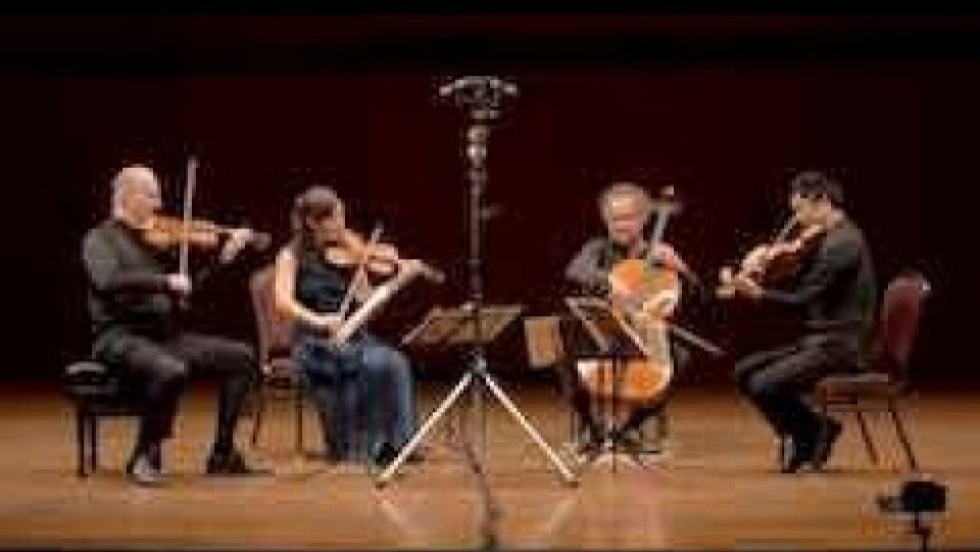
Takács Quartet at the Library of Congress
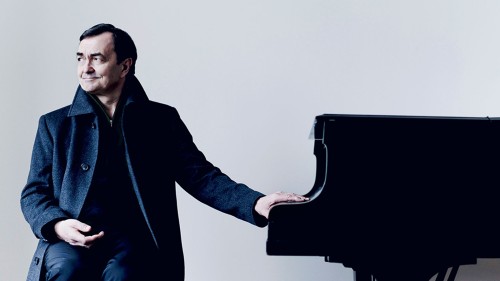

Replacing Joyce Yang, who is unable to perform due to injury
Presented by Vivo Performing Arts in association with Boston Early Music Festival