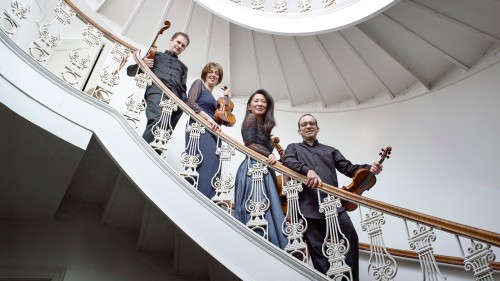
Brentano String Quartet
Flights of Fugue
FRI OCT 16 8PM
NEC's Jordan Hall
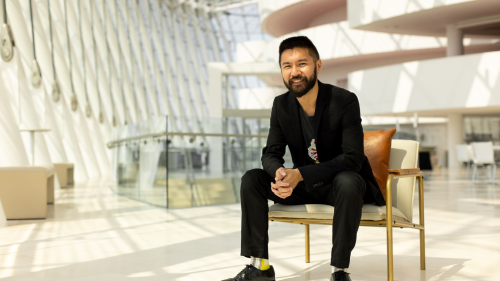
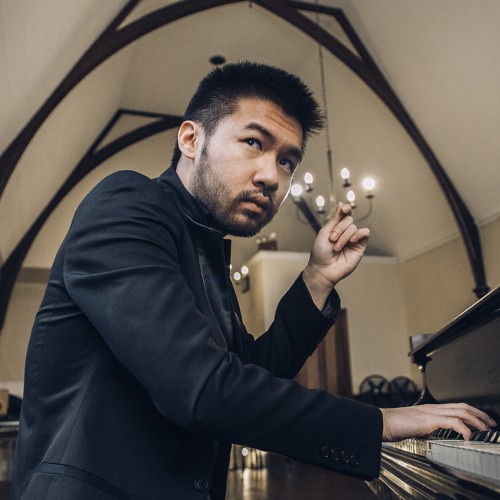
Pianist Conrad Tao wowed and delighted Vivo Performing Arts audiences earlier this year in the joyfully exhilarating Counterpoint, alongside tap dancer Caleb Teicher.
Tao returns in the new season to showcase his range and sensitivity with Poetry and Fairy Tales, a program that interweaves evocative contemporary works with well-known pieces by Brahms and Ravel.
Structure and freedom, mood and narrative, dynamism and introspection combine when Conrad Tao—an artist of “probing intellect and open-hearted vision” (New York Times)—returns to Vivo Performing Arts.
At the artist's request, there will be no late seating opportunity for this performance. Latecomers may take their seats at intermission.
“He is clearly one of the great minds to watch in the world of new music. ”
Cincinnati Business Courier
“Tao is a pianist who functions thrillingly within classical music trappings, but it was no mere gimmick that his solo return to Carnegie Hall brought a downtown sense of avant-garde to midtown. It’s in his soul. ”
Cadenza NYC
JOHANNES BRAHMS Klavierstücke, Op. 118, No. 1
DAVID FULMER I have loved a stream and a shadow, part I
BRAHMS Klavierstücke, Op. 118, Nos. 2, 3, 4
REBECCA SAUNDERS Mirror, mirror on the wall
BRAHMS Klavierstücke, Op. 118, No. 5
TODD MOELLENBERG Leg of Lamb (after Bernadette Mayer)
DAVID FULMER I have loved a stream and a shadow, parts 2 and 3
MAURICE RAVEL Gaspard de la nuit
BRAHMS Klavierstücke, Op. 118, No. 6
In “Leg of Lamb,” composed for me in 2020, Todd Moellenberg gives a pianist pitches to play as they read a poem by Bernadette Mayer; rhythms are contingent on the pianist’s speech, and thus change in every performance. Mayer’s poem takes as its subject poetry itself: “A line break / Could reflect / The way the sun breaks / Through the clouds or breakfast.”
What is the act of breaking a line? What might it imply? I like Mayer's poem because it makes me reflect on my own programming. My goal is to use juxtapositions traversing centuries in my programs to explore what might be shared DNA underneath wildly different aesthetics, and to hear familiar works in some new dimensions. I find the individual pieces and overall arrangement of Brahms’ Op. 118 Klavierstücke (piano pieces) already poetic as published; tonight, the extravagant gestures of David Fulmer’s new work, I have loved a stream and a shadow (With glitter of sun-rays, Nor with stars stretched, nor looking back from heaven)—which takes as its title and subtitle lines from Ezra Pound’s “Ortus” and “Canto III”—both interrupt and enliven the experience of hearing Brahms again. But Mayer’s poem also pokes at us: “Starting over’s our addiction, a dead / End and where does that leave us?” I’ve been constructing programs like this for about ten years now, and sometimes I wonder if I am simply falling into a pattern. I want to lean into that ambivalence, explore it, feel it out.
Rebecca Saunders’ “Mirror, mirror on the wall” also has a poetry about it. Its musical material asks us to hear between the sounds, listening not only to what is actively pushed out by the performer but the cloudier resonances that result from those actions. The familiar is reconfigured: at the center of the work is a “waltz” that appropriately centers around actions of the feet—pedal noise plays a starring role—but strips the form of its usual identifying surface features, reducing it to its meter, to the fundamental shape and feel of the dance. The piece’s title evokes the fairy tale of Snow White; when playing it I find myself reflecting on beauty, truth, and the dangers of vanity. I believe in beauty; I pursue it above all else. A commitment to true beauty demands that I not cling anxiously to any single aesthetic surface; the paradox is that it also demands attention to the surface, attention to and love of sound.
The fantastical and poetic most vividly commingle in Ravel’s Gaspard de la nuit, which takes after prose poems from Aloysius Bertrand’s heady, mysterious book of the same name. While Ravel’s subtitle is “three poems for piano after Aloysius Bertrand,” Bertrand’s is “fantasies in the manner of Rembrandt and Callot.” This is work with the fundamentals of art, and translation into different mediums, on its mind. Bertrand’s collection also extensively explores Gothic themes: the titular Monsieur Gaspard de la nuit, supposedly the true author of these poems, is also the Devil himself. Perhaps this is also a way of articulating ambivalence about the role of the artist, insisting that we consider the shadow as we revel in the sublime. And whether we are listening to the seductive coos of the ever-tragic and ever-dangerous Ondine, or observing a corpse hanging from the gallows at sunset, or hiding ourselves from the grotesque Scarbo’s mischievous pirouettes, Ravel’s music—colorful, exquisitely proportioned, capable of turning from gorgeous to terrifying in a single breath—is truly sublime.
Chopin’s Prelude – Op. 28, No. 15

Conrad Tao and Caleb Teicher visit the Steinway Factory – NY Phil
Flights of Fugue
Mozart's Clarinet Concerto
Piano
Anything But Standard: The Music of Ella Fitzgerald and Oscar Peterson