
Cancelled: Sheku Kanneh-Mason, cello & Isata Kanneh-Mason, piano
at NEC's Jordan Hall in Boston
FRI MAR 13 8PM
NEC's Jordan Hall

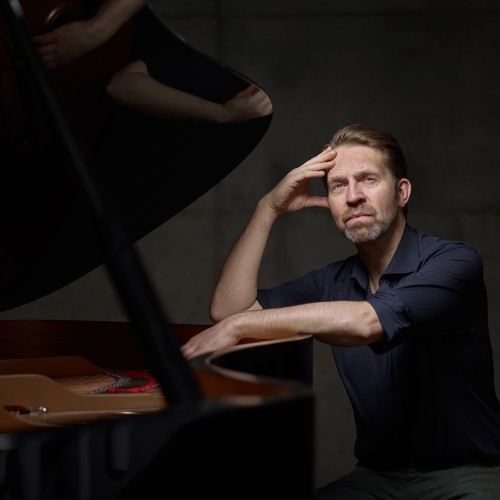
Pianist Leif Ove Andsnes returns to Vivo Performing Arts for his third appearance—but for the first time as a solo recitalist. Praised for his insightful, compelling, and elegantly virtuosic interpretations, Andsnes brings clarity and structure to every piece he performs.
Andnes brings you a program full of variety and unexpected surprises. At its center are selections from György Kurtág’s Játekók (”Games” in Hungarian), an evolving collection of short works spanning nearly five decades. With its unusual notation, extended techniques, and striking contrasts, Játekók invites a fascinating dialogue with earlier composers’ works.
Opening the program, Robert Schumann’s Four Piano Pieces are sometimes lively and dancing, sometimes lyrical, and always deeply expressive and evocative. Andsnes closes with Schumann’s Carnaval, a dazzling and theatrical suite that celebrates artistry and self-expression.
“His high musical intelligence and unerring communicative power made this journey of discovery, and rediscovery, both a tonic and a treat. ”
The ArtsDesk
“His sheer musicality and virtuosity are plain for all to see and hear. ”
Seen and Heard International
At the age of 20, Robert Schumann dropped out of a university law program to pursue music. He was “not a musical genius,” as he acknowledged in his diary, but he pursued his goals doggedly, moving to Leipzig to take piano lessons with the distinguished teacher Friedrich Wieck. He hoped to build a life as a virtuoso composer-performer, but in his efforts Schumann damaged his right middle finger permanently with an overzealous practice regimen and the use of an ill-advised mechanism to strengthen his fingers. The silver lining was that his time in the Wieck household brought him into contact with his teacher’s daughter, Clara, a gifted prodigy who would become his wife twelve years after they first met. Schumann was in Vienna in 1838 when he drafted the first three of the Four Piano Pieces, at a time when he was hoping he might be able to build a life there and have Clara join him. He added the fourth piece the next year, after his Vienna plans had fallen through, and when he was locked in a fierce legal battle with Clara’s father. Robert eventually prevailed, and during Clara’s long and successful career as a concert pianist, the Romanze from Opus 32 was one of her go-to encores. The concluding Fughette shows Schumann looking back toward the formal models of the eighteenth century.
©Aaron Grad, 2026
Selections:
Doina
Hommage à Farkas Ferenc (3) (evocation of Petrushka)
Les Adieux (in Janáčeks Manier)
Sirens of the Deluge - Waiting for Noah
Chorale for Benjamin Rajeczky’s 80th birthday
Face to face - Demény János in memoriam
Hommage à Georg Kröll 70
Born in Romania to Hungarian parents, György Kurtág moved in 1946 to Budapest, where he followed a musical path blazed earlier in the century by Béla Bartók. It was not until 1957, during a year of study in Paris, that Kurtág encountered the modern styles that had failed to penetrate the “Iron Curtain.” He took lessons from Messiaen and Milhaud, and he also transcribed many of Webern’s scores, gleaning that composer’s gifts of concision while mostly rejecting the underlying twelve-tone orthodoxy.
After finding what appeared to be a stable footing as a piano professor and respected composer, Kurtág lost faith in his direction and barely composed for five years. His breakthrough came when a colleague invited him to contribute to a collection of piano pieces for children in 1973, unlocking a new sound world and source of inspiration for Kurtág. Ever since, the short and whimsical piano works he has collected under the title Játékok (“Games”) have formed the core of his output, with the collection growing to include more than 400 pieces as of the most recent publication of Volume X, when Kurtág was 95. (And there could be more coming; he is still active as his 100th birthday approaches this February.)
Writing in the preface to the first four volumes in 1979, Kurtág explained, “The idea of composing Játékok was suggested by children playing spontaneously, children for whom the piano still means a toy. They experiment with it, caress it, attack it, and run their fingers over it. They pile up seemingly disconnected sounds, and if this happens to arouse their musical instinct they look consciously for some of the harmonies found by chance and keep repeating them.”
Each short, ephemeral piece seems to lovingly pick up and consider one small idea, be it a memory, a thought of a friend, or a tribute to a musical influence. Many are notated in open-ended ways that shape the gestures without locking the pianist into specific pitches. And if it seems improbable that a child would attempt to play these, Kurtág offers this encouragement: “Let us tackle bravely even the most difficult task without being afraid of making mistakes: we should try to create valid proportions, unity, and continuity out of the long and short values—just for our own pleasure!”
©Aaron Grad, 2026
Leoš Janáček was born into a musical family in Moravia, a region that now forms the eastern portion of the Czech Republic. After studies in Prague and Vienna, he established himself in the Moravian capital of Brno as a teacher, choir director, critic, and musicologist. It was not until much later in life that he earned his lasting reputation as the composer of Jenůfa and other landmark operas written in the Czech language.
In 1900, Janáček began composing a set of miniatures influenced by Moravian folk music and his life in that region, intending them to be played on the harmonium, a small reed organ. By 1908 the cycle had grown to ten short pieces for piano, which he published in 1911 under the title On an Overgrown Path, along with descriptive headings for each selection. As Janáček explained in a letter to a prospective publisher, the short movements “contain distant reminiscences. Those reminiscences are so dear to me that I do not think they will ever vanish.” Some of the memories are happy, including “A Blown-Away Leaf” (which Janáček described as “a love song”) and “They Chattered Like Swallows” (a reference to talkative girls); more of them are sad, especially those, like “In Tears,” composed after the death of Janáček’s daughter in 1903.
©Aaron Grad, 2026
Schumann was a talented poet in his teens before he committed himself to music, and his best early works drew upon the literary influences that had shaped his outlook since childhood, guided by his father’s tastes as a book dealer and translator. In Papillons from 1831, Schumann assembled a series of short movements to convey aspects of a masked ball from a novel by his very favorite writer, Jean Paul. Schumann returned to a similar premise for Carnaval from 1834-35, but this time he assembled his own cast of characters to populate an imagined ball during Carnival season in Venice.
Underlying the character sketches of Carnaval are several cryptic motives derived from the name of the Bohemian town of Asch, the birthplace of Schumann’s then-fiancée, Ernestine von Fricken. By rearranging the letters and rendering them different ways with German musical spelling, Schumann came up with the musical kernels that unify a work he subtitled “Little Scenes on Four Notes.”
Carnaval begins with a Preamble, using music that Schumann originally constructed within a set of variations on a theme by Schubert. Two other composers make explicit appearances in Schumann’s festivities, with a dreamy episode representing Chopin and a virtuosic intermezzo calling out Paganini. There are characters from the Italian theatrical tradition of commedia dell’arte, including Pierrot and Harlequin; Schumann’s two main alter egos appear, with Florestan representing his passionate and gregarious side, contrasted against the pensive Eusebius; Ernestine is there, as “Estrella,” and so is the young woman Schumann actually did end up marrying, Clara, Italianized as “Chiarina.” The action culminates with Schumann’s entire fictional gang, which he named after the biblical King David, marching against the uncultured Philistines of the musical world, represented by a quotation of a stuffy old tune that also appeared in Papillons—a melody that ballet lovers might recognize as the “Grandfather’s Dance” from the party scene in Tchaikovsky’s The Nutcracker.
©Aaron Grad, 2026
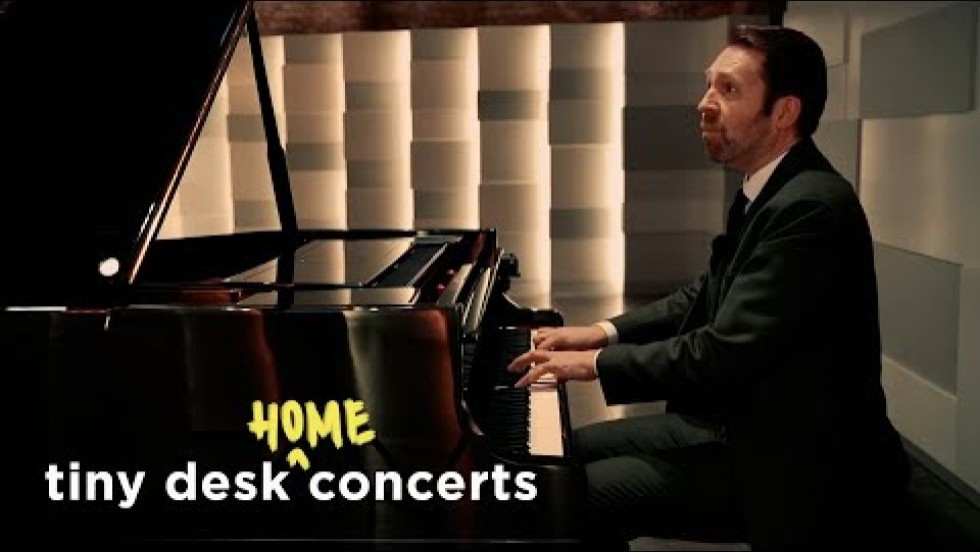
Leif Ove Andsnes – Tiny Desk Home Concert
at NEC's Jordan Hall in Boston

Poetry and Fairy Tales
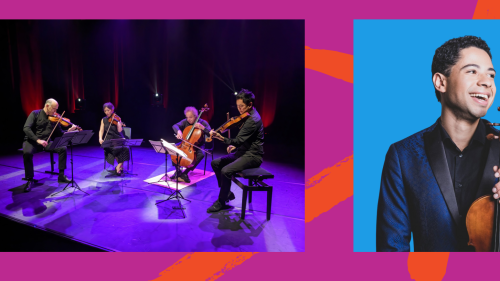
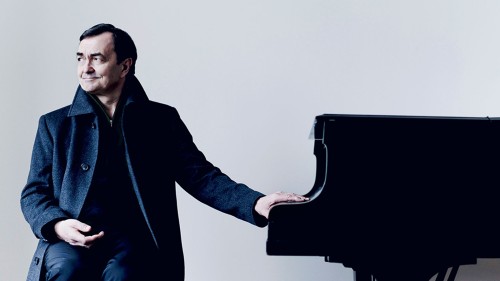

Replacing Joyce Yang, who is unable to perform due to injury