
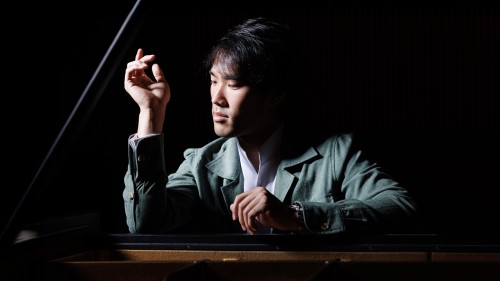
Bruce Liu
Piano
SUN OCT 18 3PM
Groton Hill Music Center
In Bruce Liu's hands, phrases and melodies shimmer and breathe like a living being. He gives playful pieces sparkle and momentum, and conveys the gravity of inward, dramatic works. His sense of flow and spontaneity refreshes beloved classics for longtime fans and newcomers alike.
Liu's program weaves day and night, fiery brilliance and nocturnal hush. From Beethoven's "Moonlight" sonata and Chopin's Nocturnes to Bach's Baroque clarity, the atmospherics of Debussy and Mompou, and dazzling Liszt, the evening is a showcase of contrast and Liu's formidable range.
“Spontaneity is a feature that makes his performances feel constantly alive. This is a pianist with a captivating musical personality.”
Financial Times
One 15-minute intermission to follow Ravel's "Alborada del gracioso"
After completing his opera Le Grand Macabre, Hungarian composer György Ligeti entered a long fallow period. For years his work had focused on timbre and the slow shifting of melodic lines to form dense, clashing harmonies. (Ligeti called this process “micropolyphony.”) He found widespread recognition when Stanley Kubrick used several of these pieces in the 1968 film 2001: A Space Odyssey.
As Ligeti struggled to assimilate a new style, he completed a handful of works including his Trio for Violin, Horn, and Piano. The Trio, alongside his early Études, helped Ligeti discover a new path. The first six études in particular were “liberating” and addictive; he completed twelve more in the ensuing years.
Ligeti borrowed the phrase “clocks and clouds” to differentiate facets of his music. Fanfares, the fourth étude, is certainly a clock. Its content emerges from a one-bar ostinato repeated over 200 times, alternating between hands and registers. Ligeti found inspiration for the piece’s rhythmic complexities in the piano music of Schumann and Chopin as well as traditional music from sub-Saharan Africa. Many of the nearly 600 chords contained in the piece are consonant, but played so quickly that they blur together and sound dissonant. (Ligeti called this effect “consonant atonality.”)
© Andrew McIntyre, 2026
After several contentious years as Kapellmeister in the small city of Köthen, Bach successfully applied for the position of Cantor at the prestigious Thomasschule in Leipzig. Amazingly, he almost failed to get the job. The interviewing council found him underwhelming, and he himself was ambivalent about the title, which he saw as a step down. The council reluctantly offered Bach the post after several applicants dropped out.
He began composing the six “French” Suites at the end of his time in Köthen and completed them in Leipzig. Bach wrote several of them for his second wife, Anna Magdalena, for keyboard practice. Bach arranges the seven movements of the G-major suite in the prevailing order of the day: allemande–corrente–sarabande–gigue. Interspersed among these are dances which provide contrasts of meter, tempo, and mood. Rather than contrast major and minor keys, Bach sets every movement in G major, a key associated with the lyrical and idyllic.
A contemporary of Bach’s wrote that the allemande “must be composed and likewise danced in a grave and ceremonious manner.” Bach obliges with a noble opening comprising two contrasting sections. The second movement, a courante, lives up to its name: this triple meter dance is indeed lively and flowing.
Bach often gave the sarabande pride of place; the stately sarabande in this suite occupies nearly a third of the performance time. A fleeting gavotte follows. Next are two more dances of French origin: a spritely bourrée and a slow, ceremonious loure (its name comes from a type of bagpipe native to northwestern France). The suite concludes with a fugal gigue.
© Andrew McIntyre, 2026
No. 1 in C-sharp minor
No. 2 in D-flat Major
Left stateless after the failed Polish revolt against the Russian Empire, Chopin built a new life in Paris. Despite his growing reputation he eschewed public concerts, instead giving intimate performances in the Parisian salons. Fellow composer Hector Berlioz complained, “Unless you are a prince, a minister, or an ambassador, you might as well give up hope of hearing him.” Consequently, Chopin turned away from flashy concert hall genres like variations and concertos in favor of small character pieces like the mazurka, the étude, and the nocturne.
Scholar Jim Samson writes, “The genre title ‘nocturne’ was fairly commonplace in early nineteenth-century piano music, influenced no doubt by the enhanced cultural status of the night…, and also by the growing importance of the salon as a site of pianism. In the hands of [Irish composer and father of the nocturne] John Field and Chopin it came to be associated with a pianistic style shaped by vocal imitation.”
Both nocturnes open with the typical “nocturne sound”: a songlike melody supported by left-hand arpeggios. The C-sharp minor nocturne contains two melodic lines in the right hand, a quasi-operatic duet for soprano and contralto. Following a brooding first theme, Chopin introduces an agitated second theme accompanied by restless bass figurations. A flourish of open octaves in the left hand signals the return of the first theme. The piece concludes with a languid, sunny coda.
Its twin, the D-flat major nocturne, teems with ornamented melodic lines. While the music builds in passionate intensity, Chopin avoids excessive virtuosity and sentimentality.
© Andrew McIntyre, 2026
Ravel, a precocious young pianist and composer, gained admittance to the prestigious Conservatoire de Paris at the age of fourteen. Though initially impressed with the boy, the faculty grew impatient and expelled him for not winning enough prizes. They re-admitted him two years later only to expel him a second time. Amidst his frustrations with the conservative faculty, Ravel joined a group of avant-garde artists and self-styled “artistic outcasts” who called themselves Les Apaches.
He began composing Miroirs after his second expulsion. Each of its movements is dedicated to a different member of Les Apaches. Ravel’s inspiration for “Alborada del gracioso” was likely two-fold. Ricardo Viñes, the dedicatee of “Oiseaux tristes,” encouraged his interest in Spanish music, while his mother’s Basque-Spanish heritage inspired Ravel to compose several Spanish-themed works, most famously Boléro.
An alborada is a love song sung to a sleeping woman at dawn, while a gracioso is a comic figure from the Spanish theater similar to a court jester. Jaunty Andalusian rhythms evoke street dancing while dry, jangly arpeggios mimic plucked guitar strings and snapping castanets. The second section opens with unaccompanied recitative, a nod to flamenco folk singing. Reflective yet at times agonizingly dissonant, the piano sings of passionate desire. In the final section, the gracioso’s strumming again becomes lively and virtuosic, whirling to a driving finish.
© Andrew McIntyre, 2026
Debussy composed Rêverie in the early 1890s amid a period of financial and artistic uncertainty. With his financial stipend from the Prix de Rome long since depleted, he struggled to make ends meet in Paris. Though he discovered a wealth of artistic inspiration in these formative years—the operas of Richard Wagner, Javanese gamelan music, Symbolist poetry, and Impressionist painting swirled around his head—his own style had yet to emerge. Even his romantic life remained unsettled; in a letter from that time, he recounted the end of yet another love affair, lamenting, “I’m still mourning the loss of the dream of a dream!”
Rêverie, one of Debussy’s earliest popular pieces, emerged years before the works that would make him famous: he composed the symphonic poem Prélude à l’Après-midi d’un faune in 1894, while the premieres of the opera Pelléas et Mélisande and La mer were more than a decade away. By then Debussy had rejected many of his youthful works, including Rêverie; he dismissed it as “a work of no consequence and I frankly consider it absolutely no good.” Nevertheless, this work remains an important precursor of Debussy’s mature style.
The tempo marking in one edition of the score, Andantino sognando, suggests walking within a dream. Though the first page is entirely devoid of chromatic notes, its tonality remains ambiguous. Similar to Chopin’s nocturnes, a cantabile melody floats over a rocking accompaniment. Hazy, gossamer textures dominate save for two brief sections of block chords which serve as signposts within Debussy’s sonic dreamscape.
© Andrew McIntyre, 2026
This sonata’s popularity was such that Beethoven himself is said to have grown weary of it. “Everyone always talks about the C-sharp minor sonata!” he complained to Carl Czerny, one of his acolytes. “Surely I’ve written better things. Why does everybody play it?” Perhaps it’s best that the nickname Moonlight, from a comparison of the first movement to “a boat visiting the wild places on Lake Lucerne by moonlight,” came into fashion after Beethoven’s death.
For the first movement, one of the most famous in all of classical music, Beethoven draws on traditions of mourning. The dotted rhythm evokes the tolling of church bells and funeral marches (this rhythm also permeates the Marche funèbre of his Eroica Symphony, which was germinating in Beethoven’s mind as he composed the sonata) while the melody further evokes liturgical chant.
A succinct and cheerful minuet and trio links the outer movements. Franz Liszt supposedly referred to it as “a flower between two chasms.” Like the preceding movements, most of the finale is played piano (quietly), but its rushing tempo and violent outbursts give this music an astounding ferocity. Beethoven composed the sonata when he was beginning to come to terms with his encroaching deafness, making it all too tempting to link this unbridled fantasy to his anger and despair. True to this narrative arc, the sonata ends with two bold fortissimo chords as pessimism gives way to defiance.
© Andrew McIntyre, 2026
One critic called Spanish-born Mompou “the only disciple and successor” of Debussy. (Debussy’s “Clair de lune” has no relation save for its similar title.) Mompou spent more than twenty years in Paris; there he fell under the influence of Debussy, Ravel, and Satie, absorbing their floating, impressionist approaches to harmony.
After the death of his wife, pianist Carmen Bravo, nearly eighty of Mompou’s unpublished works were discovered in their home. Among these were a pair of miniatures based on the traditional French song “Au clair de la lune.” Composers as diverse as Muzio Clementi, Debussy, and Samuel Barber have adapted the tune, long a staple of early music lessons. Mompou gradually introduces the melody, at times wrapping it in wistful minor-key harmonies.
© Andrew McIntyre, 2026
Albéniz completed Iberia in 1908, just one year before his death from kidney disease. The collection represents the pinnacle of his mature piano writing. Iberia contains some of the composer’s most virtuosic writing; at one point he even considered destroying the work for fear that it was unplayable.
Each of Iberia’s “new impressions,” as Albéniz called them, evokes a different part of Spain. “El Puerto,” named after a seaport on Spain’s Atlantic coast, captures the town’s relaxed but lively energy. The piece is written in the style of the zapateado, an Andalusian dance. Modal melodies and chromatic chords jostle one another amid a clash of syncopated rhythms, but these dissonances are never unfriendly; the score is marked toujours joyeux (always joyful). Flourishes in the right hand evoke rasgueado guitar strumming. The piece concludes quietly, suggesting a peaceful end to a bustling day.
© Andrew McIntyre, 2026
Depictions of Spain by foreigners were en vogue in the second half of the nineteenth century. Rimsky-Korsakov and Édouard Lalo are among those who contributed symphonic suites to the genre, but perhaps the most enduring musical evocation of Spain is Bizet’s magnum opus, Carmen. Liszt, who had visited the Iberian Peninsula in the 1840s, made his own contributions. The most famous of these, completed nearly twenty years after a tour of Portugal and Spain, is the Rhapsodie espagnole.
The piece contains a virtuosic series of variations on two themes. “La folía” (Spanish for “folly” or “madness”) makes its entrance low in the bass clef. This well-worn dance tune originated on the Iberian Peninsula and has remained a centuries-long source of inspiration for composers including Corelli, J. S. Bach, Vivaldi, and Rachmaninoff.
Following increasingly florid variations on “La folía,” Liszt introduces the second tune, the jota aragonesa, in the piano’s upper register. The jota, a popular genre of Spanish folk dance, is traditionally danced in pairs and accompanied by guitar, fife, or gaita (bagpipes). The jota variations swell to a triple-forte climax. A short cadenza in parallel thirds leads to a grandiose conclusion, a major-key restatement of “La folía.”
© Andrew McIntyre, 2026

Bruce Liu | Chopin: Nocturne in C Sharp Minor, KK IVa/16

Piano

Violin & Piano