
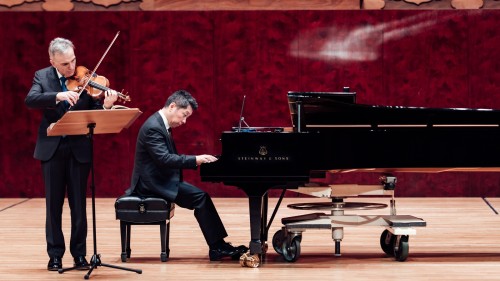
Gil Shaham & Akira Eguchi
Violin & Piano
THU JAN 14 8PM
Groton Hill Music Center
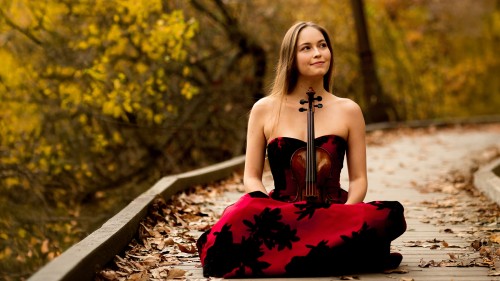
Geneva Lewis—a rapidly rising star on the international stage—makes her Vivo Performing Arts debut with a program of striking emotional range and intention. Praised for her lustrous tone and the rare ability to unite fervent passion with immaculate precision, Lewis moves from Mozart's surprising, nocturnal G-Major Sonata into the tender longing of Silvestrov's miniatures, the somber weight of Weinberg's survival-haunted sonata, and the electric intensity of Webern. With Strauss' early violin sonata—glowing, love-struck, and radiantly alive—Lewis brings this distinguished debut to a spirited and joyful close.
“Clearly one to watch.”
Musical America
In the spring of 1781, Mozart finally broke with his hated employer, the Prince‑Archbishop of Salzburg and settled in Vienna to pursue an independent career as composer, conductor, pianist, and teacher. He worked hard to earn his living, seeking out every possible source of income. He wrote four of his dozens of sonatas for violin and keyboard during that spring and summer, adding two earlier ones to make a set of six that was published by subscription in November. He wrote to his father in Salzburg that as soon as he got some money from the sale of them, he would send it home.
Since the young composer was not yet positioned to dedicate the sonatas to a wealthy nobleman for a fine fee, he inscribed them to his best pupil, Josepha Aurnhammer, a young woman whose musicianship he admired, although as a person, he found her repellent. “She is a fright,” he said, “but plays enchantingly.” One of the big hits of the concert season that fall was their performance of the Concerto for Two Pianos that he had written two years earlier to play with his sister. Aurnhammer became one of Vienna’s best pianists, and she also published several original compositions.
It may now seem peculiar that the sonatas were dedicated to a pianist, not a violinist, but the eighteenth century viewed these works rather differently than we do now. The title of the first edition read, in French, “Six Sonatas for the Harpsichord or Pianoforte with the Accompaniment of a Violin,” giving the instruments recognition that is the reverse of present‑day usage. At the time, however, it was still customary to think of the violin as the accompanying or secondary instrument and to write sonatas so that the keyboard part could be complete by itself and thus the violin dispensable. Some of the earliest Mozart works to be printed were violin sonatas, but they were then called piano sonatas with violin accompaniment. Proficient amateurs enjoyed playing such compositions in their homes to entertain their guests or even just for their own pleasure.
Mozart gradually changed this imbalance, however, and through the years made the violin parts of his sonatas progressively more independent, more nearly the equal of the keyboard instrument. One sensitive reviewer wrote of this set of sonatas, with some surprise, “They are the only ones of their kind, rich in new ideas, and they reveal the composer’s great genius. They are brilliant works in which the violin accompaniment is so artfully combined with the keyboard part that both instrumentalists must be constantly on the alert. They require just as skillful a player on the violin as on the harpsichord.”
The composer told his father that he wrote this sonata on April 7, 1781, during the hour from 11 p.m. to midnight for violinist Antonio Brunetti, concertmaster of the Salzburg court orchestra and an old friend. When he and Brunetti played it at a concert the next day, he had completely written out the violin part, but not the piano part, which, he said, he had kept in his head.
It is perhaps because time was so short that Mozart made this work only a two‑movement sonata. He enlarged the first movement, however, by beginning it with a big, slow, dramatic introduction, Adagio, which some are tempted to consider as almost a separate movement itself. A dynamic and impassioned Allegro with great dramatic intensity follows. Notably, its development section is quite brief, but an expanded recapitulation with a bit of further development makes up for it.
The second movement consists of a gentle theme, Andantino cantabile, with distinctive trills that reappear in most of the six variations that follow. The variations also contain particularly exquisite emotional passages. The recapitulation of the theme benefits from its more flowing speed, which increases its intensity. An Allegretto coda follows, containing more brilliant figuration. Finally, Mozart ends the sonata gently. (Presumably, Schubert knew the sonata well and, according to Misha Donat, in liner notes, based his only song in variation form, “Im Früling” D. 882, on a theme that sounds very similar to Mozart’s final variation in the second movement.)
© Susan Halpern, 2026
Average duration: 21 minutes
World War II did not allow Valentin Silvestrov to have a usual childhood; as a result of wartime disruptions, he was not able to begin music lessons until he was fifteen. From 1955 to 1958, he attended the Kyiv Evening Music School and then began a university program in construction engineering. Feeling an overwhelming attraction to music, he dropped out of university to enter Kyiv Conservatory instead; there, he studied composition and counterpoint under Borys Lyatoshynsky and Levko Revutsky. Even during his student years, he wrote music that captured attention because of its eclectic style, in which he sometimes contrasted tonal passages with completely atonal ones.
Silvestrov, although scarcely known in the West, became one of Ukraine’s most prominent composers. Alfred Schnittke and Arvo Pärt both called him “one of the greatest composers of our time.” Silvestrov began writing music using what were then considered avant-garde modernist techniques. Over time, his music evolved stylistically; in later works, he created a new musical language, an individual postmodernist mix, yet one still including spiritual language.
In 1963, Silvestrov composed the first of his nine symphonies. As his music matured, he developed a unique style that has been labeled postmodern; he describes it as allegorical or metaphorical. He used traditional styles in many of his compositions, to which he added tonal and modal harmonies. By the ’60s he began to gain attention as a prominent member of the Kyiv Avant-Garde, but he had to endure pushback from conservative Soviet officials.
He taught at a music studio for several years before becoming a freelance composer in Kyiv in 1970. In both the 1960s and 1970s, his music was rarely performed; premieres of his works, if given at all, occurred primarily in Russia, in Leningrad (now St. Petersburg), or in the West; nevertheless, he was awarded the Koussevitzky Prize in 1967. In 1974, Silvestrov and his music came under attack, partly because he had condemned the 1968 Soviet invasion of Czechoslovakia and partly because his music did not conform to either the precepts of what was known as Socialist Realism or the official modernist styles that the Soviet musical establishment had approved.
He was banned from the Association of Russian composers for his protests against the stifling cultural bureaucracy. As a result, he withdrew completely from public musical activities for fifteen years, composing music exclusively for private performances. He only returned to the public sphere in 1991 after the fall of the Soviet Union, when he began composing choral works that used the spiritual language of Orthodox church music. Despite the success of his performances in the West (the composer himself was not allowed to attend them), Silvestrov’s music frequently met with little or no response in his own country.
His work shows the influence of Gustav Mahler, with whom he is often compared. In Silvestrov’s view, one of the prerequisites for the continued existence of music today is melody, which he also regards in an expanded sense of the term. He included Ukrainian nationalist elements in some of his works, causing him to feel a need to flee to Berlin, Germany, during Russia’s 2022 invasion of Ukraine.
In recent decades, he has become even more independent, leaving behind the compositional devices of the avant-garde, saying, “the most important lesson of the avant-garde was to be free of all preconceived ideas—particularly those of the avant-garde.” He discovered a style he has called “metamusic,” a shortened form of “metaphorical music.” “Metamusic” is a synonym for a universal style (a concept that Silvestrov has adhered to in the last decades) and a universal language that he understands to mean a language that belongs to no one, but anyone can use in his or her own way.
The composer would like his works to be seen as “codas” to musical history because “fewer and fewer texts are possible which… begin at the beginning”. He has declared that “I do not write new music. My music is a response to and an echo of what already exists.” And although it may sound as if the end-point of such a philosophy must inevitably be silence, Silvestrov has repeatedly proven what a uniquely fertile compositional space this can be. Malcolm MacDonald put it more poetically; Silvestrov, he wrote, composes not the lament itself “but the lingering memory of it”.
As critic Paul Griffiths noted: “Time in Valentin Silvestrov’s music is a black lake. The water barely moves; the past refuses to slide away; and the slow, irregular stirrings of an oar remain in place. Nothing is lost here.”
Valentin Silvestrov’s Two Pieces for Violin and Piano (2020) is a delicate, contemporary chamber work comprised of two contrasting movements: “Pastoral” and “Barcarola,” the first marked Walzer, Allegro assai, which is to say in waltz time, and the latter “Weihnachtsserenade,” a Christmas Serenade, Moderato.
They form an example of Silvestrov’s late-style “bagatelle” aesthetic, characterized by a nostalgic, fragile, and distant tone, in which melodies sound like faded echoes of romantic 19th-century traditions. In the composer’s own words: “Con moto, poco rubato, dolce, leggiero, lontano—these terms at the beginning of the score occur repeatedly in almost all my compositions, not only in those many smaller pieces (for various ensembles, mostly collected into cycles) I have been composing in the past ten years. One could call these years my ‘Period of Bagatelles.’ Here, however, the small genres (fr. bagatelles = harmless trifles) are not simply mere musical irrelevancies, but sublime trivialities; they represent a whole philosophy, a way of thinking.
“The short form makes it possible to capture the moment as it is and make it linger on (Ah, linger on, thou art so fair! after Goethe), without imposing the burden of what is termed “thematic elaboration.” In other words—the development of a moment musical is not the most important aspect of the music, nor even is its timbre, but rather the clarity and distinctiveness of the melody and the possibility to recognize it, to recall and to repeat it….What I am trying to do is to transform the musical style of bygone times, i.e. simple elements of the musical texture (such as triple meter, sequences, triads) by giving it a multi-dimensional, metaphorical meaning, and, despite any “neo”-connotations, a sense of modernity. Born out of silence and dissolving into silence, my music may leave a strangely rare reverberation in the interpreters’ and listeners’ awareness.”
© Susan Halpern, 2026
Average duration: 6 minutes
Andante con moto
Allegro molto
Allegro moderato
Allegro Andante — Allegretto — Andante
Date of composition: 1953
Average duration: 27 minutes
Regarded as one of the most important Soviet Russian composers, Mieczyslaw Weinberg created a prolific musical oeuvre, including 26 symphonies, 17 string quartets, and seven operas. Many have hailed Weinberg as the neglected third of three 20th-century great Russian composers, the others being Shostakovich and Prokofiev.
Weinberg's Moldavian father worked as a musician in the Jewish theatre, and predictably, it was from him that the composer became acquainted with music. He continued his studies at the Warsaw Conservatory, graduating in 1939, shortly before Hitler swept through Poland. By 1940, Weinberg had gone to Minsk, Belarus, 300 miles east of Warsaw, to study composition with Vassily Zolotaryov. In the summer of 1941, just before the Germans invaded Russia, he moved to Tashkent, 2000 miles away in eastern Uzbekistan, where he found work at the local opera house.
Although he eventually settled permanently in Moscow, he only happened to be in the Soviet Union after he fled Nazi-occupied Poland when the Germans invaded. By settling in Tashkent when he did, he escaped the fate of many of his countrymen during World War II. While he was in Tashkent, theatre director Solomon Mikhoels, a Latvian Jew whose daughter Weinberg later married, sent the score of Weinberg's Symphony No. 1 to Shostakovich, who was very impressed. Shostakovich urged his young colleague to settle in Moscow, where he ultimately made his home from 1943 until his death. A lifelong friend, Shostakovich considered Weinberg one of the country’s most eminent composers.
Weinberg’s prolific musical output is often compared to that of his revered teacher, friend, and occasional protector, Dmitri Shostakovich. It also exhibits the romantic melancholy and melodic invention typical of the music of another colleague, Sergei Prokofiev. Virtually unknown outside of Russia at the time of his death, Weinberg's music has seen a great resurgence of interest.
In early 1953, shortly after Weinberg and his wife moved to Moscow, Stalin bizarrely charged the composer with conspiring to establish a Jewish republic in the Crimea, which resulted in Weinberg’s being arrested by Stalin’s secret police and then imprisoned and tortured in Lubyanka Prison. It was feared that he and his wife might be killed while they were incarcerated. It is likely that only Stalin’s death in early March 1953, after suffering a massive stroke, saved Weinberg from execution. Weinberg was released shortly after Stalin’s passing. Soon, he was back in Moscow, and as Shostakovich had become both his mentor and friend, Weinberg benefited from the comparatively lavish life of a celebrity composer in Moscow.
Weinberg composed his emotionally powerful Sonata No. 5, Op. 53, soon after he was released from the Lubyanka prison in 1953; he dedicated it to his friend Dmitri Shostakovich. The work received its premiere on December 30, 1955, performed by violinist Mikhail Vaiman and pianist Maria Karandashova in Leningrad/St.Petersburg.
The sonata is regarded as the best and the most mature work of Weinberg's for violin and piano. It is a grand work, monumental in size and written in an almost symphonic manner. It is divided into four movements: the first is slow (Andante con moto) and the following three are all some form of Allegro: Allegro molto, Allegro moderato and Allegro (although the final movement moves from the initial Allegro to Andante, then gets a little faster to Allegretto, and finally concludes as Andante, similar in tempo to the sonata’s beginning. The parts for both violin and piano are equally demanding, although the piano performs most of the solo fragments. For this sonata, Weinberg, as he so often did, drew from the tradition of Russian, Polish, and Jewish music. The piano’s rich, thick texture, the sonata’s thematic lavishness, numerous transformative fragments, as well as the clear, logical structure prove the unusual dimension of this masterpiece. The emotionally powerful Sonata No. 5, like many of Weinberg’s works, has a melodic subtlety that conceals deep and probing emotion. It alternates an unsettled feeling of bleakness with a sense of emotional warmth, an eloquent expression of the events of Weinberg’s troubled life.
The initial Andante must rank among the composer’s most affecting, its main theme stated by piano and violin in turn before touching on more tangible emotions. Around the movement’s mid-point, the violin sounds a more anguished tone, but the music soon regains its elegiac character and heads toward a plaintive close. Next comes an Allegro in which the main themes contrast, being spirited and then sedate before this movement builds to a vehement climax. Then the second theme diffuses the intensity before a more restrained recapitulation, followed by an ambiguous ending. The Allegro that follows is playful but also sardonic. A muted violin converses with the piano that articulates strong emotions before blithely scampering to a reflective conclusion. The finale opens with violin arpeggios and halting piano chords that head to a pleasant melody with a few capricious excursions. These lead to the movement’s piano climax, while the violin goes on to initiate a reprise of the main theme, before a coda where the work’s initial theme reappears for an emotional farewell.
© Susan Halpern, 2026
Sehr langsam
Rasch
Sehr langsam
Bewegt
Date of composition: 1910, revised in 1914
Average duration: 5 minutes
Anton Webern was an Austrian composer who stood apart from his contemporaries stylistically, except perhaps in terms of his use of the twelve-tone system of writing. Yet even among those who wrote twelve-tone music in the early 20th century, he established his own tenets rather than joining with other followers of that tradition. Notwithstanding his small output of compositions, Webern’s musical importance is significant. Although Webern’s opus numbers run only to 31, and they contain only around four hours of music in total, the musical expressions of the microcosms he created are so condensed, his craft so precise, and his ideas so pure in conception that his works influenced the composers of Europe and America during the twentyfive years after the Second World War more than did those of any other single composer. Much of his music is made up of the most minute material. Arthur Cohn made an accurate analogy when he said Webern’s “music is like an abstraction of a short story, which, in turn, mostly consists of punctuation signs, and furthermore has only a few of these.”
Webern composed his Four Pieces for Violin and Piano, Op. 7, in 1910, at the beginning of a period of about five years that he was to devote to making his works as concise and as concentrated as possible. The Four Pieces last only about five minutes altogether, but they seem to encompass a whole world of expression, following the dictum of Webern’s master, Arnold Schoenberg, who said that a poem could be contained in a glance, a novel in a sigh. Each of these tiny pieces is a pithy aphorism whose every note and every silence Webern loaded with meaning and expression. Dynamic polarity is a defining feature of these four terse compositions. The first and third pieces are never louder than a pianissimo (very soft), while the second and the fourth pieces have both highs and lows of dynamic intensity. The first piece is very slow (Sehr langsam); the second, quick (Rasch); the third, very slow (Sehr langsam); and the fourth, agitated (Bewegt).
© Susan Halpern, 2026
Allegro, ma non troppo
Improvisation: Andante cantabile
Finale: Andante - Allegro
Average duration: 30 minutes
Richard Strauss’ father was a dogmatically conservative musician who brought his son up on a strict diet of Haydn, Mozart, and Beethoven and did not allow him to know the “radical” works of Chopin, Schumann, and Brahms, let alone those of Liszt and Wagner. Yet children inevitably deny the strictures of their parents. This composition was the young composer’s last backward look, although he was not looking far enough back to suit his father. The sonata shows all too clearly that Strauss was already on intimate terms with the music of Schumann and Brahms. Its wide-ranging themes also tell of the new Richard Strauss who, while composing the sonata, was also working on his first aggressively and fiercely modern works, the symphonic poems Macbeth and Don Juan. Yet some observers claim to find in the sonata some references to Schubert’s Erlkönig and Beethoven’s Appassionato Sonata.
Interestingly, Strauss wrote only chamber music in his early years; he composed this sonata in 1887, in Munich, where he was a twenty-three-year-old staff conductor at the Royal Court Opera. It was published in 1888 and quickly became a favorite with violinists. The second movement was so popular that it was often performed separately on recital programs. The sonata has three big movements densely packed with musical substance, and it is equally brilliant and equally demanding for both instruments.
It opens with a powerfully developed Allegro, ma non troppo, which uses the idea of two themes following the idea of the sonata form. Then comes a luxuriant “Improvisation,” Andante cantabile, music resembling a Chopin nocturne, with a contrasting middle section that is, in effect, the sonata’s scherzo. The third movement is as full and rich as a concerto-finale, with piano writing that sometimes has qualities of the orchestral. In this movement, the brilliant sound foreshadows qualities Strauss would develop in his later works in other musical forms. Beginning with a short introduction for piano, Andante, the brooding subject foreshadows the heroic main theme of the Allegro, which ends with a great coda.
© Susan Halpern, 2026

Geneva Lewis | Bach Partita No. 3: Preludio
Violin & Piano