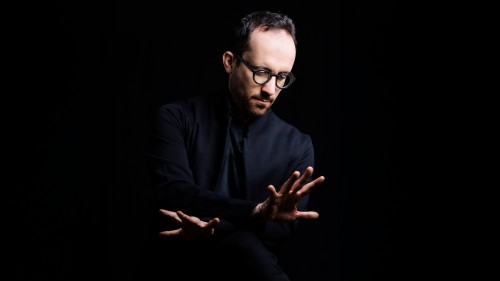
Igor Levit, piano
All-Beethoven program
SUN NOV 08 3PM
Symphony Hall
One of the most important pianists of his generation meets the composer at the center of his artistic life. Fearless, searching, and utterly individual, Igor Levit has become one of the defining pianists of our time.
For Levit's Symphony Hall solo recital debut, he turns to Beethoven in a program spanning four sonatas, from the restless energy of Beethoven’s youth through the turmoil of the "Tempest" before ending on the luminous, monumental "Waldstein."
“The early [sonatas] sport a playful, classical air about them, and yet there is always more on offer beyond just that... an entirely consistent cycle.”
Financial Times
“It was a 'Waldstein' for the books and indeed a concert to remember, one in which Levit the artist showed that Beethoven the humanist is as contemporary as ever.”
South China Morning Post
“Igor Levit is like no other pianist.”
The New Yorker
The son of an obscure musician, born and raised in a provincial town in western Germany, Beethoven yearned for something greater. Tutored by his strict and sometimes abusive alcoholic father, he gained attention as a virtuoso even as a child; one early notice compared him to a young Mozart. Shortly before his twenty-second birthday, Beethoven left Bonn to seek his fortune in Vienna, the city that would become his lifelong home.
Barely one month after Beethoven’s arrival his father died; the death went unremarked in his son’s diary. What the diary does show are preoccupations with finding a piano, a quality tailor, and a wig-maker; and commencing his composition lessons. Beethoven studied with Haydn for about a year before the old master embarked upon one of his famed trips to London. Headstrong and at times overly sensitive to criticism, Beethoven wasn’t always a grateful pupil (Haydn’s misgivings about one of his Opus 1 piano trios left Beethoven convinced of his teacher’s jealousy). He dedicated the three Opus 2 sonatas to Haydn, but in private he declared that he had never learned anything useful from him. Despite his bruised, youthful ego, Beethoven later regarded Haydn with reverence and affection.
Though he was still years from verbalizing his desire to walk a “new path,” these early published works already push against tradition. Where Haydn and Mozart almost exclusively used a three-movement layout for their sonatas, Beethoven uses a four-movement scheme (by adding a minuet or scherzo) in most of his early sonatas. The addition of the fourth movement, one usually reserved for more distinguished genres like the symphony and string quartet, broadcast not only an elevation of the piano sonata as a genre but of Beethoven as a serious new talent.
Beethoven launches into his first piano sonata with a rapid ascending figure known as a Mannheim Rocket; he later contrasts this upward staccato melody with a descending, legato second theme. The small turn in the second measure reappears throughout the movement in various guises. The transformation and development of small, seemingly insignificant musical gestures foreshadow Beethoven’s mastery of this technique in works including the Fifth Symphony. The turbulent music shows the influence of the proto-Romantic Sturm und Drang movement, whose works are characterized by dark, minor keys; drastic changes of dynamics, tempo, and mood; syncopation; and harmonic dissonance. Following a loud return of the opening material, the movement concludes after a delayed, almost frustrated resolution.
Beethoven borrowed from an unpublished teenage work for the slow second movement. It opens with a tender, highly decorated theme above an undulating accompaniment. Light, florid passagework in the right hand dominates the second theme. Each theme is repeated with embellishments before the movement ends in a tranquil coda.
Sudden dynamic contrasts, syncopation, and dramatic pauses characterize the melancholic minuet in the third movement. A contrasting trio section contains a flowing melody that passes between both hands.
The stormy finale presents similar contrasts as driving chords hammer over a line of running triplets. Following a lyrical major-key middle section, the opening material returns for a tempestuous conclusion where triplets and thundering chords have switched hands.
© Andrew McIntyre, 2026
Among the 135 works published in Beethoven’s lifetime, thirty-two are piano sonatas. Of these, the first twenty were written in the eight years prior to 1803. Many of these show a clear deference to the Classical traditions codified by Haydn and Mozart, yet Beethoven grew frustrated by these strictures. In a famous statement made to Carl Czerny, one of his piano students, he mused, “I am only somewhat satisfied with my previous works. From today on I will take a new path.”
Yet this path was not without stumbling blocks, as a tremendous personal crisis threatened to derail all. Beethoven’s hearing loss, which had begun in his twenties, grew increasingly worse as he entered his thirties. The loss of his hearing made composition difficult, eventually made public performance impossible, and nearly drove Beethoven to suicide.
On his doctor’s advice, in 1802 Beethoven retreated to the small town of Heiligenstadt. He hoped that the quiet of this “holy city” might save him, but in the silence he found something else entirely. He drafted a last will and testament to his brothers that remained undiscovered until his death. This impassioned missive, now known as the Heiligenstadt Testament, reveals his anguish at the loss of his hearing. “But what a humiliation when one stood beside me and heard a flute in the distance and I heard nothing or someone heard the shepherd singing and again I heard nothing! Such incidents brought me to the verge of despair. Little more, and I would have put an end to my life—it was only my art that held me back.”
It was during this tumultuous period that he completed the trio of Opus 31 piano sonatas, including the most famous of the set, The Tempest. Like the Sonata No. 1, the opening movement shows the influence of Sturm und Drang. Its first eight bars contain four distinct tempo changes as Beethoven presents two contrasting moods: an ascending major-key arpeggio, almost a pastoral sunrise in sound, followed by squalls of blustery eighth notes. The music unfolds in a gloomy whirlwind as the melody plunges into the piano’s murky bass. An insistent knocking gesture, followed by a slow descent in octaves, serves as a signpost between sections. Ominous rumbling in the bass pervades the brief development. Following a stormy return of the mercurial opening material, the movement concludes with a pianissimo coda Czerny likened to “distant thunder.”
The tranquil, unhurried second movement comes as a welcome respite. Its opening echoes that of the first movement, and the pervasive drum-like figure in the bass serves as a reminder of the distant yet all-too present storm.
A restless moto perpetuo dominates the third and final movement. According to Czerny, its galloping rhythms were inspired by horses Beethoven heard outside his window in Heiligenstadt. He uses unaccompanied, oscillating chromatic lines to transition between sections. Much like the first movement, the finale comes to an abrupt pianissimo end, a three-octave descent reaffirming the sonata’s pessimistic conclusion.
© Andrew McIntyre, 2026
While living in Vienna, Beethoven survived not one but two invasions by Napoleon’s forces. The first of these, in November 1805, arrived mere months after the premiere of Beethoven’s Third Symphony. Nicknamed Eroica, the symphony famously bore a dedication to Napoleon until he crowned himself emperor. When he heard this news, Beethoven furiously scratched out Bonaparte’s name.
Napoleon invaded again in the spring of 1809. During a brief siege, his forces unleashed artillery fire from twenty howitzers, throwing the city into chaos. Beethoven took refuge with his brother, sister-in-law, and two-year-old nephew. To protect his hearing, he fled to the cellar, covering his head with pillows to muffle the sounds of the bombardment.
With the battle over and life regaining some normalcy, Beethoven resumed composing; among the works he completed were a trio of piano sonatas, including the G-major sonata. “We are enjoying a little peace after violent destruction,” he wrote to his publisher after the French left Vienna, “after suffering every hardship that one could conceivably endure. I worked for a few weeks in succession, but it seemed to me more for death than for immortality. … What do you say to this dead peace? I no longer expect to see any stability in this age.”
The Opus 79 sonatas are among the last Beethoven completed during his middle period. Thanks to powerful works such as his Third and Fifth Symphonies, the rescue opera Fidelio, and the Waldstein Sonata, it has often been deemed his “heroic” period. Never one to be pigeonholed, Beethoven also composed small-scale, intimate works in this era, including the G-major sonata. At scarcely ten minutes long, it ranks among the shortest sonatas he ever wrote (in fact, it is the only one of his pieces that Beethoven himself referred to as a sonatina, or “little sonata”).
The sonata begins with a sparkling, uptempo waltz “in the German style.” An obsessive motif of a falling third gives the sonata its nickname: “Cuckoo.” The first movement concludes with a rustic dance; coarsely accented notes seem to imitate a raucous village band.
Beethoven continues to depict amateur music makers in the tranquil middle movement. In this melancholic barcarolle, the bass evokes the sculling of a gondolier as the treble intones what Sir András Schiff describes as “two lovers singing.” A brief, playful finale in rondo form concludes the sonata.
© Andrew McIntyre, 2026
Before his departure from Bonn, Beethoven was given a friendship book containing farewell messages from friends and supporters. One of his early patrons, Count Ferdinand Ernst Gabriel von Waldstein, left an auspicious note:
Dear Beethoven: You are going to Vienna in fulfillment of your long-frustrated wishes. The Genius of Mozart is still mourning and weeping over the death of her pupil. She found a refuge but no occupation with the inexhaustible Haydn; through him she wishes once more to form a union with another. With the help of assiduous labor, you shall receive Mozart’s spirit from Haydn’s hands. Your true friend, Waldstein.
Despite Waldstein’s early support, this sonata is the only work Beethoven dedicated to him. He completed the sonata alongside the Eroica Symphony, one of his most famous works from the so-called “heroic period.” Indeed, one of Beethoven’s early biographers referred to the Waldstein as “a heroic symphony for piano.”
The first movement presents two contrasting themes: the first powerful and striving, the second relaxed and graceful. A combination of triplets and four-note arpeggios heighten the sense of restlessness. In the development, the driving theme appears in a minor-key guise. A low bass tremolo beneath an ascending treble line signals a return of the opening material. The movement ends with a triumphant coda.
The solemn second movement serves as an extended introduction to the third, a rondo. The rondo begins with a soft melody played with crossed hands that soon builds to a fortissimo. Stately and turbulent themes fight for dominance, alternating until the sonata concludes in a virtuosic, grandiose coda replete with glissandi and trills.
© Andrew McIntyre, 2026

Igor Levit, Waldstein Sonata: Preview

Igor Levit, piano | Beethoven Sonata No. 14, "Moonlight”
All-Beethoven program

Piano

Piano
piano
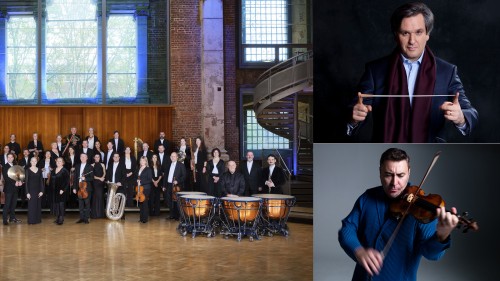
Sir Antonio Pappano, chief conductor & Maxim Vengerov, violin soloist