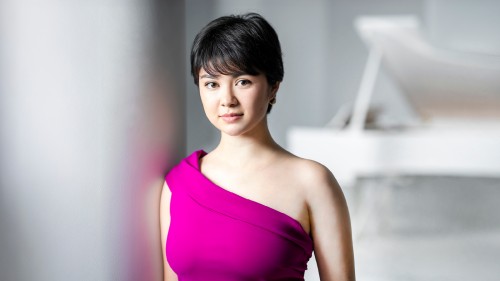
Avery Gagliano
Piano | Debut Series
THU OCT 08 7:30PM
Longy's Edward M. Pickman Hall
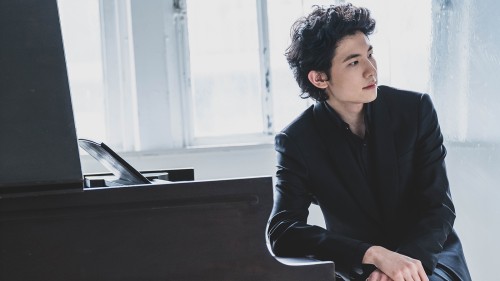
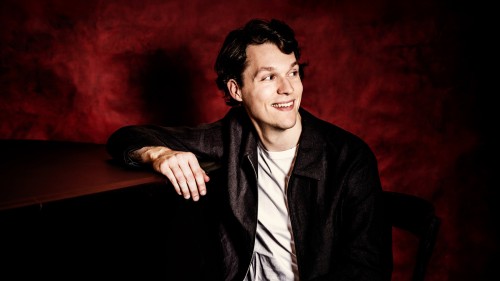
Still in his early 20s and only two years out of Juilliard, Canadian pianist Tony Siqi Yun is already making waves as a soloist and recitalist. Praised for his refinement, muscular sound, and intimate expressivity, Yun has “an emergent big personality” (Philadelphia Inquirer) that makes him a pianist you’ll want to experience firsthand.
Yun’s debut program spans lyrical Bach/Busoni, Beethoven's radiant "Waldstein" Sonata, Berio's crystalline Wasserklavier, Liszt's virtuosic Réminiscences de Norma, and Brahms' epic Piano Sonata No. 3. It's a thrilling journey through color, clarity, and intensity—perfectly suited to showcase the expressive range of this rising star.
A compelling introduction to a must-hear young artist, the program promises to showcase the poetry and power that set Tony Siqi Yun apart on the global stage.
“Tony is a true poet of the keyboard. Expressive, and with his own distinct voice, yet elegant and poised. ”
Pianist Magazine
Ferruccio Busoni (1866-1924) grew up in a time when it would still have been considered unusual for an Italian to show much interest in the music of J.S. Bach. The revival of Bach’s music in the nineteenth century was mostly relegated to Germany and England and his compositions were not yet considered a shared worldwide heritage. When Busoni was young, however, his father insisted he study Bach. It is perhaps partly because of this rarity and sense of specialness that Bach was such an important figure for Busoni, whose so-called “Bach-Busoni Editions” are a touchstone of modern piano literature and one of the major achievements of the eminent musical polymath’s life.
Busoni treats the dignified Chorale Prelude Ich ruf zu dir Herr Jesu Christ, BWV 639 for organ delicately in accordance with his system of Bach transcriptions. For Busoni, the salient distinction among Bach’s keyboard works is whether they were written for organ, which sustains, or an instrument like harpsichord or clavichord that is struck or plucked. The latter could be more easily translated to modern piano with very little editing required. The former, however, presents a couple of clear issues to the modern performer. A piano cannot sustain, and it produces sound by striking the strings, creating a sharp initial timbre that transforms over time. An organ also has foot pedals and registration options that enable it to have a larger range and depth of sound. To correct for this, Busoni doubled the bass notes and called for liberal use of the damper pedal, rounding the attack and allowing the strings to better sympathetically vibrate with each other to give the sense of continuous sound. The result is an extraordinarily sensitive interpretation of Bach’s work, something that combines the depth and clarity of the organ works with the sense of intimacy and intricacy that typifies the keyboard works.
© 2026 Connor Buckley
Of the many innovations Ludwig van Beethoven (1770-1827) pioneered in western classical composition, one of the most striking is that texture can be more important than theme. Other composers had experimented with this idea, but by the time Beethoven wrote his Piano Sonata No. 21 in C Major, “Waldstein,” in 1803/04, he had made it his signature sound. His Fifth Symphony, dating from about the same time, is the most famous application of the texture-first approach. The “theme” of that first movement is hardly a theme at all, but merely many iterations of the famous fate-knocking-on-the-door motif. What could be dull and repetitive is instead, through Beethoven’s imaginative orchestration, one of the most sublime and influential pieces ever written.
The Waldstein Sonata is an exercise in this same concept, informed in part by Beethoven’s 1803 acquisition of a new piano made by the French maker Erard Frères. The sound and technical capabilities of this piano with four foot-pedals (rather than the conventional three) delighted him, and he began to write with its unique voice in mind. The piece’s iconic sewing machine rumble of an opening was likely written out of fondness for the instrument’s low register resonance.
What makes that beginning so satisfying is its concentration on orchestration rather than melodic theme. Beethoven understood that music is about experience, that it is not fundamentally an external object. This is often why listeners interpret his music as passionate. The force of that left hand tremolo, the delicacy of the upper register motifs, and the steady emergence of those arpeggios all contribute to an ineffable sense of excitement.
It is not just textural shifts on their own that make this piece so kinetic and vibrant, but the rate that those shifts occur. This movement is one of Beethoven’s most rhythmically sophisticated works. Towards the ends of phrases, patterns shorten or quicken, and the interplay between right and left hand will be more frenetic during points of transition. As always in Beethoven, sharp contrast between fast and slow, pointed and gentle lend the piece a sense of drama and adventure.
The second-movement Adagio molto is tender but halting. It is essentially a transition point between the first and third movements and can largely be thought of as an austerely pared down version of the first movement’s gestures, reflecting its predecessor’s harmonic progressions, the shape of its melodic fragments, and the rate of interplay between right and left hand. Again, rhythmic inventiveness propels the listener forward. By distilling and lengthening the concepts already presented, Beethoven creates a neutral landing zone for meditation and contemplation that prepares the listener for a new direction.
At the beginning of the Rondo, the sky opens. Finally, a hummable melody. The experience of the first two movements is so intense and dramatically satisfying that the listener can forget that they have essentially been listening to arpeggios, scales, and fragments that suggest melody until now.
Beethoven is perhaps the greatest composer of variation, always wringing out his material for extra development. He takes full advantage of the rondo’s form for this purpose, fracturing his theme into manipulatable bits and using it to inform each digression. This is especially clear in the central theme (the second digression), a heaving, emotionally heavy sequence that contrasts starkly with the pianissimo initial theme and yet arises from chunks of that theme. Simultaneously, the listener hears increased emotional intensity, dramatic development, and recontextualization, as the return to the main theme now reappears in light of this heightened drama. The piece continues to develop along these lines until a sudden quiet overcomes it. Just as it seems it will end subdued, though, a presto coda propels the listener to a lively and triumphant close.
© 2026 Connor Buckley
When Franz Liszt (1811-1886) wrote his Réminiscences de Norma in 1841, opera, especially Italian opera, was culturally ascendent. It was the preeminent form of public entertainment for the new bourgeois class of Europe. Like with movies in the early twentieth century, everyone seemed to attend the opera and they did so frequently. Popular operas like Vincenzo Bellini’s Norma permeated the zeitgeist enough that hardly anyone would have escaped knowledge of its favored melodies.
Liszt himself was similarly ascendent. The 1840s marked the apex of Lisztomania, a feverish collective state of fanaticism for the composer, who, apart from being as gifted as any performer has ever been, was unusually good looking, incredibly charismatic, and a shameless showboat. Stories abound of people fainting in excitement at his packed performances and trying to collect keepsakes of his personal effects like his handkerchief or even locks of his hair.
A lot has been written about how this frenzy for Liszt came about, but one essential characteristic that gave his performances such mystique was that he was a peerless improviser. He would embellish anything, including, to the chagrin of the musical intelligentsia of Europe, a composer like Bach. The thrill of attending a Liszt recital was compounded by the sense of mystery about what he would play, and each moment of the concert took on more and more emotional significance as the unexpected revealed itself in real time.
Liszt also cultivated devotion by the sheer force of his intensely virtuosic showpieces like the Réminiscences. Broad analysis of the piece is relatively easy to sum up: it is a series of embellished popular melodies and it is very difficult to play. What makes the piece so special is that it is about as close as we can get to hearing the great Liszt improvise, and what a wonderfully complex improvisation it is. It is not like an overture, with rote recitations of the melodies, or even a theme and variations with disciplined exploration of minimal material. As the title suggests, Liszt is recalling themes and unravelling them as he sees fit. What results is a combination crowd-pleaser and pursuit of the sublime, something that Liszt excelled at better than anyone. Even today, Liszt, performed well, can still elicit a spiritual experience to those in the right headspace.
© 2026 Connor Buckley
Luciano Berio (1925-2003) was one of the great avant-garde composers of the twentieth century. To many, this is a euphemism for “inaccessible.” But Berio, along with Stravinsky, was perhaps the greatest composer of pastiche in the same era. He was not beholden to any particular compositional dogma exclusively and his startling technique and imagination made it so he could effortlessly write in any style he felt like paying homage to. Nowhere is that clearer than in his little encore pieces, to which his "Wasserklavier" (water piano) belongs.
The piece is essentially an ode to late Romantic piano music and is especially reminiscent of late Brahms. It unfolds with a cascading texture of gently flowing arpeggios, evoking rippling water. The notes shimmer delicately, each figure melting into the next almost imperceptibly. The music never rises above a whisper, gently drawing the listener into its intimate, dreamlike world. Berio’s harmonic language is rooted in the past but possesses a core of subtly dissonant modernism that makes the piece shimmer. It is hypnotic and undeniably beautiful, showcasing Berio at his playful best.
© 2026 Connor Buckley
Johannes Brahms (1833-1897) was part of a group of Romantic composers that prominently included Clara and Robert Schumann and prized classical forms over the modernist rule-breaking aesthetic of Wagner and Liszt. The “War of the Romantics,” as the conflict is often called, was fought mainly on the front of published compositions. Brahms was the wunderkind of the conservative movement, enthusiastically branded as quasi-Messiah by Robert Schumann in his famous essay, “Neue Bahnen” (new paths). His Piano Sonata No. 3 in F minor is a landmark in this fertile period of western music, a proof of concept for Schumann whose hyperbolic assertions may have initially seemed fanciful.
Brahms dedicated his life to the Beethovenian model of composing, where all beautiful things are fundamentally efficient but appear grand. His music feels bountiful, luxurious, and rich, so much so that it is shocking to find upon close inspection that its extravagant beauty comes from quite small parcels of material. Here, the analogy to Beethoven is more direct as the famous fate motif from the fifth symphony is used as defining material. The pattering triplet figure is fungal, and once it is introduced the listener has no choice but to hear its insistent chime mutated throughout every movement.
The piece performed today is a quintessential young person’s composition: it tries to contain everything. Brahms haughtily announces this ambition from the start. The fortissimo chords span the entire register of the piano as if to declare that anything the piano can do will be done. It begins intensely but searchingly and restlessly. As it hems and haws between majestic chords and fervent lyricism like a bright fire being snuffed to embers over and over, it hardly ever seems to resolve, only doing so triumphantly with brightly textured major chords at the very last moment.
The second movement is Baroque in character, beginning like a short, delicate air for harpsichord reminiscent of Handel or Rameau. As Brahms unfolds the material, though, it transforms itself into the densely woven Romantic texture that its poetic inspiration suggests. Above the first bars of the movement, Brahms quoted the poet C.O. Sternau:
Through evening's shade, the pale moon gleams
While rapt in love's ecstatic dreams
Two hearts are fondly beating.
The architecture of the movement suggests a slow burn romance, patient at first but with steadily gathering intensity that easily exhales into contentment in the end.
The scherzo begins comparatively aggressively. The fate motif returns more insistently in the contrasting lyrical section as if a reminder to the lovers that their bliss will inevitably pass. Again reflecting Beethoven, textural contrast is intense and frequent, drawing the listener in to attend to every moment.
The fourth movement intermezzo is a reprieve, like a curtain has been drawn on an opera for a scene change. The music is delivered discursively and feels impermanent. Even the fate motif here is whispered as if at any point the piece will simply disintegrate with no resolution. The subtitle, “Rückblick,” or remembrance, refers to the first theme of the second movement, which appears here in minor, perhaps implying some tragic development in the lovers’ story.
The beginning of the finale is essentially a resolution of the final moments of the intermezzo, its rhythmic punch snapping the piece back to attention. It is a grand reincarnation after the fall of the fourth movement, propelling forward with eager exploration as each moment recontextualizes what has come before. The rondo form volleys the listener back and forth between its initial statement and contrasting sections, building intensity until the piece ends as it began, thunderously, though this time not restlessly but emphatically.
© 2026 Connor Buckley
Piano | Debut Series
Piano
Piano

Piano
Debut Series