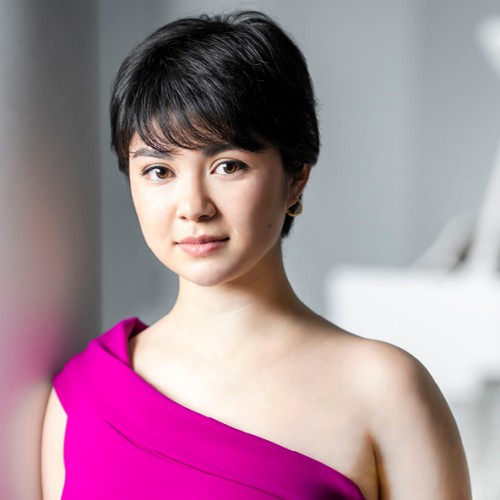
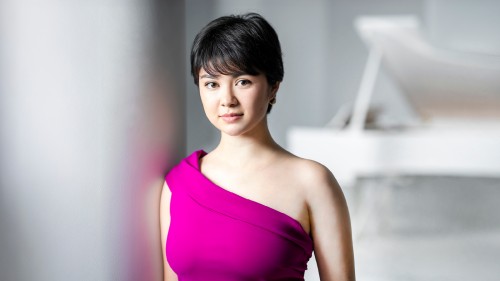
Avery Gagliano
Piano | Debut Series
THU OCT 08 7:30PM
Longy's Edward M. Pickman Hall
Celebrated as "a distinctive young talent" (International Piano), pianist Avery Gagliano's concerts offer a "distinctly narrative approach" (Miami International Piano Festival). She makes her Vivo Performing Arts debut with an audacious program that demonstrates her prodigious command of mood and structure. From the luminous to the relentless, from the gauzy to the percussive, and concluding with Schumann's all-encompassing Symphonic Etudes, Gagliano offers a recital that announces her as an artist of assured command.
“Her ability to inhabit every room in the immense imagination of Frédéric Chopin came as a revelation.”
New York Classical Review
In the 1830s, Robert Schumann was writing much of the most revered piano music of his career. His Novelletten, Op. 21 (a set of eight pieces) are typical of the period: dramatic, intense, and difficult, with the narrative quality of a work of literature. The one heard today, No. 8 in F-sharp minor: Sehr lebhaft is the longest and perhaps most intense of the bunch.
Narrative is the key to understanding this work, more specifically Schumann’s apparent belief that musical narrative is most strongly felt through stark contrast. The piece thrives on duality. Really, it is two pieces of similar form cemented together. Each of these pieces is further divided into contrasting sections of percussive intensity and, at turns, broad and tender lyricism. Schumann was a peerless orchestrator at the piano and uses the moods of the piece as an excuse to examine and showcase the varying shades of piano textures.
The right-hand / left-hand communication is another embodiment of the duality of the piece. Their symbiosis throughout is a primary driver in the form. Rather than leave the melodic action to the right hand and relegate the left to accompaniment, both hands contribute essentially and equally to the progression of the piece, ushering each other to each new phase. The bass motion in the left hand is especially strong and functions as a secondary melody whenever a primary theme is being showcased. It is Composition 101 taken to the most skillful degree, leaving no shortage of nuance for the listener to pay attention to.
© Connor Buckley, 2026
Average duration: 12 minutes
Gabriel Fauré was one of the most important composers in the bridge period between Romanticism and Modernism. His harmonic sensitivity and formal daring were extremely influential on the generations immediately following him, especially on his compatriots Debussy and Ravel. His Ballade in F-sharp Major, Op. 19, is an essential early work, almost a thesis statement for his entire career—graceful and charming, difficult without showboating, and complex while retaining an elegant accessibility. It was a major contribution to intellectual life in the early Belle Époque and was probably the inspiration for the haunting fictional sonata in Proust’s In Search of Lost Time.
The piece is a combination of the ambition of Liszt and the grace and delicacy of Chopin. Its elegance belies its extraordinary difficulty. It was originally conceived as a multi-movement work akin to the shape of a standard sonata or concerto, but, in Lisztian fashion, Fauré compressed the material into one long multi-episodic arc.
Fauré’s work here is partly the product of late Romanticism, relying on the patterns of traditional forms to give the piece a sense of cohesion and internal unity. It also anticipates the boundary-smashing work of Debussy’s Modernism, feeling to the listener like a long improvisation. It resembles a discursive miniature by Chopin in mood, but maintains a kind of Beethovenian rigor in its large-scale formal organization.
There are three primary themes in the piece, each with its unique character that showcases Fauré’s skill as a melody writer. They are elegantly stated and restated, augmented, gilded with flourishing arpeggios, and otherwise treated with the kind of grandeur that the Romantics preferred in a well-composed piece. There is classical symmetry as well, as sections of each theme are often repeated in call-and-response fashion.
Much of what gives the piece its sense of freshness and surprise, though, is Fauré’s harmonic inventiveness. What Fauré realized was that harmony was the great contextualizer of music. His compositions don’t present harmony for its own sake, but apply it as part of a holistic vision, changing how the listener might receive a particular moment in time. Because of this, traditional harmonic analysis of Fauré’s work tends to fall short. A here-this-chord-then-this-one approach does not fully communicate how the harmony frames the mood of a melody, makes certain rhythmic gestures feel quicker or more relaxed, or punctuates significant moments in the form. Many of the greatest composers knew this, but Fauré was particularly good at realizing it. In his Ballade, Fauré relies on the harmony to surprise the listener, especially at the ends of phrases and in transitional moments in the form. Here is a work of music, its harmony part of a larger, complete musical experience.
© Connor Buckley, 2026
Average duration: 15 minutes
Frederic Rzewski (ZHEF-skee) was one of the most important American composers of the late 20th and early 21st centuries. He was especially known as a composer-pianist and his works for piano are looked on with great fondness by the wide world of piano geeks. His work is energetic, forceful, almost polemical, often written with explicitly political inspiration. He is one of the few composers who truly made the case for music's pure rhetorical power. He was as well-respected as a pianist as he was as a composer, notably working on Anthony Braxton's monumental Creative Orchestra Music 1976.
Rzewski's political music can be placed in the broader tradition of program music, or music written with an extra-musical narrative in mind. This genre has a long history starting in the Romantic era. It became popular to justify abandoning traditional abstract formal structures, allowing composers to feel as if they were writing freely while also helpfully being limited and guided by the standard-bearing narrative arc.
Rzewski’s program in “Winnsboro Cotton Blues” is a twofold commentary: one a sympathetic narrative, and one a meta-textual historical commentary. On the one hand, it is a story of labor and leisure among Black cotton workers. On the other, it is an argument for the foundations and development of modern American music.
Liszt’s Mephisto Waltz No. 1 is a touchstone. Rzewski replicates its formula of preparation / activity / rest / activity to offer a glimpse of rural life and labor. For Liszt, the basis was a peasant celebration, from the primordial ooze of a tuning band to a raucous dance party that calms and reenergizes in turns as the dancers tire and excite. It is a statement on the idea of leisure among those who work hardest in society. Rzewski politicizes the formula, but similarly evokes the idea of a primitive gesture that soon gives way to a fully textured musical world. On the way, he repeats an argument for the foundation of modern American music.
Jazz and other 20th-century modernist genres that emerged from the American Industrial Revolution are often seen as reactions to a mechanized environment. The racket of machinery and its consistent tick, the incessant hum of traffic, and the dehumanizing repetition of work brought about by hyper-specialization and the division of labor under capitalism all forced a human artistic response to make sense of the noise, so the theory goes. Rzewski employs this idea to expert effect. From the mechanistic rumble of a cotton mill at the start to a tour of boogie-woogie, rag, jazz, and blues, the piece portrays modern genre as a natural expression of human imagination when confronted with a rapidly changing world.
© Connor Buckley, 2026
Within the broader genre of solo piano music, there is a somewhat eclectic sub-genre that could be called "piano geek" music. This is music written by and for pianists, music for which the highest praise is, knowingly, "they write well for the piano." Chopin's music fits this mold, as does Liszt's, Ravel’s, and both Clara and Robert Schumann’s. Gifted practitioners of the art of piano performance write this music. Like any niche subculture, it has its subtle in-group signifiers. Non-pianists may not notice what makes these pieces preferable, but pianists sure do, and much of the standard repertoire for the instrument is built on this knowledge and its associated preferences.
Leon Kirchner was primarily a composer, but his gifts were wide-ranging, and he was an excellent pianist. His work for piano, especially his late works, have the ineffable sense of someone in the know. It is piano geek music par excellence, and it has increasingly become standard repertoire among pianists looking for something to perform outside of the well-trodden collection of pieces from the late Romantic period.
His Interlude II has become especially popular. Although written in Kirchner's identifiably modern style, the piece owes much of its sensibility to the norms of late Romantic music, especially the iconoclastic music of another piano geek, Alexander Scriabin. The work throughout is discursive and rhapsodic. Like Scriabin, its harmonic inventiveness is more about providing shape and contrast to ongoing melodic lines, moving here and there as the composer sees fit, rather than progressing through a standardized scheme where one block of sound is tied functionally to another. Where Kirchner departs from Scriabin is in the formal structure. Unlike much of late Romantic music composed using traditional forms, Kirchner's piece is more modernist, with no clear map other than a sense of what might be interesting. The composition overall is not about rote procedure, but a kind of mindful occupation of each moment. Its purpose is the journey the listener experiences while listening.
© Connor Buckley, 2026
Average duration: 6 minutes
Robert Schumann was a paradox of a composer. In his life and art, he seemed to balance on a thread between contradictions. He was a great supporter of the community of composers around him, of young talent and of those who supported his fiercely defended critical ideals, yet he was in life mostly a loner who invented an imaginary society of composers in lieu of any real group of friends. He had major mood swings, perhaps from what we would call bipolar disorder today, and oscillated between periods of fanatic productivity and melancholic introspection. He was also a defender of classical ideals and forms whose music seemed more interested in exploring the very modern precept that content dictates form. It would be easy to choose just one of these perspectives to analyze Schumann from, but this would be an incomplete portrait. He was all these things, a fully fleshed, deeply complex person who tried to lead the life of a quintessential Romantic, passionate and obsessively art-forward.
Schumann’s Symphonic Etudes, Op. 13, is as enigmatic as the composer himself. Notoriously difficult to perform, the composition has a history of alterations and additions that makes it just as difficult to pin down conceptually. The piece began as a challenge to write variations on a theme by Baron von Fricken, an “amateur,” as Schumann referred to him in the first title of the work, though additional movements from later publications do not follow the form of variation. The titling of the work as well was relatively chaotic, having changed many times over the course of its composition and publication. At one time, it directly referenced Schumann’s imagined dueling creative forces, the outgoing Florestan and the introspective Eusebius, who provided a frame and creative outlet for the composer’s mood swings. The two were eminent members of Schumann’s imagined society, the Davidsbund, who, with their sophisticated compositions, heroically triumphed over the ignorant pop culture Philistines. The imaginary creators’ imprint can still be seen throughout the Etudes.
The changing nature of the piece has meant that the order of the variations is dictated by the performer, making it difficult to summarize as a large-scale piece. What remains consistent in every performance is Schumann’s characteristic sound world, his aesthetic that unifies formal competence, virtuosity, and pure emotion. While most movements do vary the original theme, this is merely a jumping-off point. The Symphonic Etudes are fundamentally about the idiosyncrasies of the piano. The movements are highly structured, but the scaffolding feels like it buckles under the weight of texture and color. Sublime is the correct descriptor here. Though the piece is demanding to both performer and listener, all anyone can do is be in awe of Schumann’s music.
© Connor Buckley, 2026
Average duration: 33 minutes
Piano | Debut Series
Piano | Debut Series
Guitars | Debut Series
Debut Series