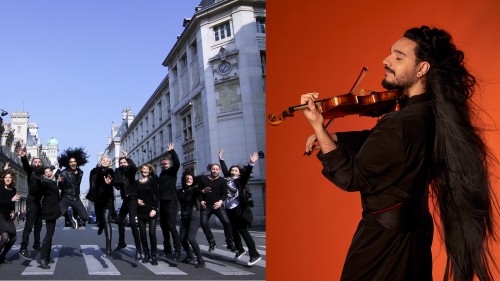
Nemanja Radulović & Double Sens
FRI NOV 13 8PM
NEC's Jordan Hall
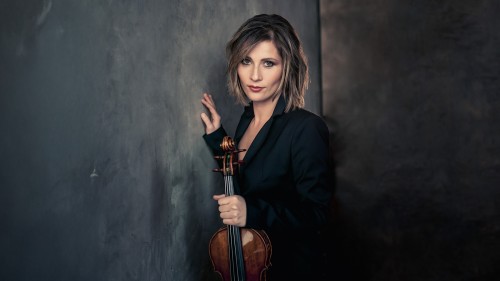
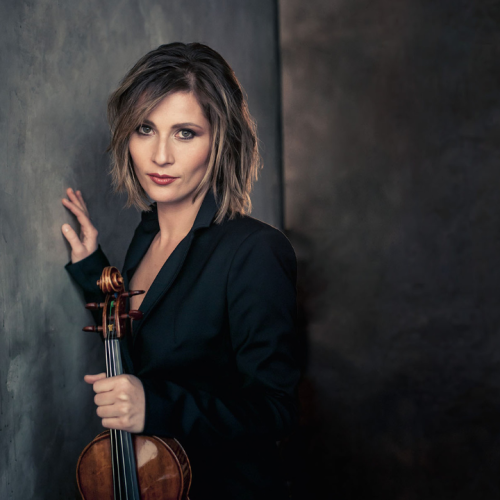
Beloved by audiences worldwide for her playing that is “fearless…tonally rich and technically immaculate” (The Guardian), violinist Lisa Batiashvili returns to the Series after her acclaimed 2023 performance alongside pianist Jean-Yves Thibaudet and cellist Gautier Capuçon. Don’t miss your chance to witness an artist who effortlessly blends delicacy with intensity and lyricism with precision in a rare duo recital with Giorgi Gigashvili.
Batiashvili's program features an early Beethoven sonata, showcasing her special affinity for the composer, as well as Prokofiev's brooding Violin Sonata No. 1 in F minor, Op. 80. The sonata, begun before the Second World War and completed in its shadow, is a work of stark beauty and emotional depth.
The program concludes with Franck’s Violin Sonata in A Major—a radiant, rarely heard masterpiece originally written as a wedding gift—that Batiashvili performed “fervently and beautifully” (San Francisco Classical Voice) on her 2022 album Secret Love Letters.
“She played with pure, gorgeous tone and fabulous technique... Could you have fairly asked for more? The audience, to judge from its standing ovation, was fully content. ”
The New York Times
Allegro con spirito
Adagio con molt' espressione
Rondo. Allegro molto
Beethoven wrote ten violin sonatas, a concentrated body of works, which have become the foundation of the violin sonata repertoire and are extremely popular. The first nine date from the brief period between 1797 and 1803, and the last from 1812. When he wrote the first three in 1797 and 1798, the custom of the time still generally confined sonatas to private performance in the home, although Beethoven and his friend Ignaz Schuppanzigh played at least one of them (we do not know which one) at a public concert on March 29, 1798. At the year’s end, Beethoven published the music with a dedication to his teacher of vocal writing, the Imperial Kapellmeister Antonio Salieri (1750-1825), from whom he took lessons for at least a decade.
Beethoven played the violin from the age of eight, but he was most at home on the keyboard and was extolled as the greatest pianist of his time. However, as a practical musician of his generation, he knew the violin well and wrote fluently and idiomatically for it.
This Beethoven sonata and others of the period are model works of the years in which he added his own accents to the classical language of Haydn and Mozart, developing the musical forms inherited from his two great predecessors into vehicles of powerful expression without precedent. Today’s listener might find it hard to imagine the experience of Beethoven’s contemporaries for whom this sonata presented a challenge consonant with what we might term problematic modern music; consequently, these new sonatas were not altogether well received. An early critic describes the first three in this opus, saying that they were strange and bizarre, and he found them “overladen with difficulties.” After struggling through them, he said, “I felt like a man who had hoped to take a walk through a pleasant park with a friend but found the path closed by hostile barriers, and at the end returned exhausted without having had any pleasure. Nevertheless, this work must not be entirely rejected. There are those who love difficulties, and they may find delight and satisfaction in this music.” [Abridged].
A generation earlier, a sonata of this type would always have been described as a sonata for harpsichord or piano “with the accompaniment of a violin,” and then it was generally expected that the keyboard part would be complete in itself. Mozart had broken down this convention by writing indispensable violin parts in his sonatas. The critics of Mozart’s day were surprised to discover that Beethoven’s sonatas had gone one step further in the same direction and required two players of equal skill. Beethoven finally and irrevocably, but not easily, established this new balance of power, and thus these sonatas occupy an important place in the repertoire, as the violin no longer offers an optional accompaniment to a solo piano sonata but serves as the piano’s equal partner. (The harpsichord, which could not meet the demands of Beethoven’s intended dynamic range here, would not have been an option for the performer.)
More serious than the first two sonatas in the set, this sonata has an energetic first movement, Allegro con spirito, with both instruments very active, although the piano, demonstrating some elements of Beethoven’s virtuoso piano writing, does have a far more intense technical challenge. The violin, however, does get to sing the gentle second subject. The development section of this sonata form movement begins by treating the themes sequentially, allowing them to modulate to new keys, and at the central section's conclusion, the two instruments indulge the listeners with a short but wide-ranging thematic line over a tremolando accompaniment before the movement ends with an agreeable coda.
In the emotionally moving second movement, Adagio con molt'espressione, Beethoven offers a characteristic main theme, a long serene melody that evolves slowly over a double-dotted rhythm. This first theme, as in a song’s introduction, appears first in the piano. It is then featured in long lines in the violin part over a soft and gentle accompaniment. Eventually, the two instruments exchange roles for this lyrical and expressive utterance.
The cheerful finale, Rondo: Allegro molto, introduces a contrasting mood with its humorous repeated note motif and a dramatic main theme. In the center section of the movement, Beethoven introduces harmonic explorations in the minor mode and seems to suggest that some differences may be brewing between the violin and the piano. This feeling, however, is dissipated by the transition to a fugal treatment of the primary subject, which then takes the two to a short but distinctly good-natured coda for its ending.
Beethoven wrote ten violin sonatas, a concentrated body of works, which have become the foundation of the violin sonata repertoire and are extremely popular. The first nine date from the brief period between 1797 and 1803, and the last from 1812. When he wrote the first three in 1797 and 1798, the custom of the time still generally confined sonatas to private performance in the home, although Beethoven and his friend Ignaz Schuppanzigh played at least one of them (we do not know which one) at a public concert on March 29, 1798. At the year’s end, Beethoven published the music with a dedication to his teacher of vocal writing, the Imperial Kapellmeister Antonio Salieri (1750-1825), from whom he took lessons for at least a decade.
Beethoven played the violin from the age of eight, but he was most at home on the keyboard and was extolled as the greatest pianist of his time. However, as a practical musician of his generation, he knew the violin well and wrote fluently and idiomatically for it.
This Beethoven sonata and others of the period are model works of the years in which he added his own accents to the classical language of Haydn and Mozart, developing the musical forms inherited from his two great predecessors into vehicles of powerful expression without precedent. Today’s listener might find it hard to imagine the experience of Beethoven’s contemporaries for whom this sonata presented a challenge consonant with what we might term problematic modern music; consequently, these new sonatas were not altogether well received. An early critic describes the first three in this opus, saying that they were strange and bizarre, and he found them “overladen with difficulties.” After struggling through them, he said, “I felt like a man who had hoped to take a walk through a pleasant park with a friend but found the path closed by hostile barriers, and at the end returned exhausted without having had any pleasure. Nevertheless, this work must not be entirely rejected. There are those who love difficulties, and they may find delight and satisfaction in this music.” [Abridged].
A generation earlier, a sonata of this type would always have been described as a sonata for harpsichord or piano “with the accompaniment of a violin,” and then it was generally expected that the keyboard part would be complete in itself. Mozart had broken down this convention by writing indispensable violin parts in his sonatas. The critics of Mozart’s day were surprised to discover that Beethoven’s sonatas had gone one step further in the same direction and required two players of equal skill. Beethoven finally and irrevocably, but not easily, established this new balance of power, and thus these sonatas occupy an important place in the repertoire, as the violin no longer offers an optional accompaniment to a solo piano sonata but serves as the piano’s equal partner. (The harpsichord, which could not meet the demands of Beethoven’s intended dynamic range here, would not have been an option for the performer.)
More serious than the first two sonatas in the set, this sonata has an energetic first movement, Allegro con spirito, with both instruments very active, although the piano, demonstrating some elements of Beethoven’s virtuoso piano writing, does have a far more intense technical challenge. The violin, however, does get to sing the gentle second subject. The development section of this sonata form movement begins by treating the themes sequentially, allowing them to modulate to new keys, and at the central section's conclusion, the two instruments indulge the listeners with a short but wide-ranging thematic line over a tremolando accompaniment before the movement ends with an agreeable coda.
In the emotionally moving second movement, Adagio con molt'espressione, Beethoven offers a characteristic main theme, a long serene melody that evolves slowly over a double-dotted rhythm. This first theme, as in a song’s introduction, appears first in the piano. It is then featured in long lines in the violin part over a soft and gentle accompaniment. Eventually, the two instruments exchange roles for this lyrical and expressive utterance.
The cheerful finale, Rondo: Allegro molto, introduces a contrasting mood with its humorous repeated note motif and a dramatic main theme. In the center section of the movement, Beethoven introduces harmonic explorations in the minor mode and seems to suggest that some differences may be brewing between the violin and the piano. This feeling, however, is dissipated by the transition to a fugal treatment of the primary subject, which then takes the two to a short but distinctly good-natured coda for its ending.
Beethoven wrote ten violin sonatas, a concentrated body of works, which have become the foundation of the violin sonata repertoire and are extremely popular. The first nine date from the brief period between 1797 and 1803, and the last from 1812. When he wrote the first three in 1797 and 1798, the custom of the time still generally confined sonatas to private performance in the home, although Beethoven and his friend Ignaz Schuppanzigh played at least one of them (we do not know which one) at a public concert on March 29, 1798. At the year’s end, Beethoven published the music with a dedication to his teacher of vocal writing, the Imperial Kapellmeister Antonio Salieri (1750-1825), from whom he took lessons for at least a decade.
Beethoven played the violin from the age of eight, but he was most at home on the keyboard and was extolled as the greatest pianist of his time. However, as a practical musician of his generation, he knew the violin well and wrote fluently and idiomatically for it.
This Beethoven sonata and others of the period are model works of the years in which he added his own accents to the classical language of Haydn and Mozart, developing the musical forms inherited from his two great predecessors into vehicles of powerful expression without precedent. Today’s listener might find it hard to imagine the experience of Beethoven’s contemporaries for whom this sonata presented a challenge consonant with what we might term problematic modern music; consequently, these new sonatas were not altogether well received. An early critic describes the first three in this opus, saying that they were strange and bizarre, and he found them “overladen with difficulties.” After struggling through them, he said, “I felt like a man who had hoped to take a walk through a pleasant park with a friend but found the path closed by hostile barriers, and at the end returned exhausted without having had any pleasure. Nevertheless, this work must not be entirely rejected. There are those who love difficulties, and they may find delight and satisfaction in this music.” [Abridged].
A generation earlier, a sonata of this type would always have been described as a sonata for harpsichord or piano “with the accompaniment of a violin,” and then it was generally expected that the keyboard part would be complete in itself. Mozart had broken down this convention by writing indispensable violin parts in his sonatas. The critics of Mozart’s day were surprised to discover that Beethoven’s sonatas had gone one step further in the same direction and required two players of equal skill. Beethoven finally and irrevocably, but not easily, established this new balance of power, and thus these sonatas occupy an important place in the repertoire, as the violin no longer offers an optional accompaniment to a solo piano sonata but serves as the piano’s equal partner. (The harpsichord, which could not meet the demands of Beethoven’s intended dynamic range here, would not have been an option for the performer.)
More serious than the first two sonatas in the set, this sonata has an energetic first movement, Allegro con spirito, with both instruments very active, although the piano, demonstrating some elements of Beethoven’s virtuoso piano writing, does have a far more intense technical challenge. The violin, however, does get to sing the gentle second subject. The development section of this sonata form movement begins by treating the themes sequentially, allowing them to modulate to new keys, and at the central section's conclusion, the two instruments indulge the listeners with a short but wide-ranging thematic line over a tremolando accompaniment before the movement ends with an agreeable coda.
In the emotionally moving second movement, Adagio con molt'espressione, Beethoven offers a characteristic main theme, a long serene melody that evolves slowly over a double-dotted rhythm. This first theme, as in a song’s introduction, appears first in the piano. It is then featured in long lines in the violin part over a soft and gentle accompaniment. Eventually, the two instruments exchange roles for this lyrical and expressive utterance.
The cheerful finale, Rondo: Allegro molto, introduces a contrasting mood with its humorous repeated note motif and a dramatic main theme. In the center section of the movement, Beethoven introduces harmonic explorations in the minor mode and seems to suggest that some differences may be brewing between the violin and the piano. This feeling, however, is dissipated by the transition to a fugal treatment of the primary subject, which then takes the two to a short but distinctly good-natured coda for its ending.
© Susan Halpern, 2026
Andante assai
Allegro brusco
Andante
Allegrissimo – Andante assai
Prokofiev was a notable Russian composer of the first half of the 20th century who worked and lived both in Europe and America as well as in his own homeland. He was born in a remote Ukrainian village where his agronomist father worked as manager of a large estate. His mother gave him his first music lessons. He studied at the Conservatory in Saint Petersburg where he became a brilliant pianist. After the Russian Revolution, Prokofiev came to America and then settled in Paris, where he was an influential figure until his return to Russia in 1933.
Late in 1938, Prokofiev began to sketch a violin sonata, but before long, some larger projects demanded his immediate attention, and he temporarily abandoned it, finishing only in 1946. First, he constructed a cantata for concert performance from the music he had composed for Sergei Eisenstein’s film, Alexander Nevsky. Next, he wrote a five-act opera, Semyon Kotko, for performance in 1940. Then the Second World War forced him to leave his Moscow home for safety in a remote area of Russia, where he worked on the two principal compositions of his late years, the Fifth Symphony and the opera, War and Peace. Wherever he went, he carried the sketches for this unfinished sonata with him to work on. In 1946, he finally completed it, and on October 23, the renowned violinist, David Oistrakh, gave it its first performance. Prokofiev had, in the meantime, written another violin sonata (which is an alternate version of his Flute Sonata), but he called this one his first because he had begun it earlier.
The sonata is an original, powerful, dramatic composition, whose rich thematic material is strongly Russian in character. Imaginative Soviet critics thought Russian epic-narrative poetry inspired it and they presumably heard in it such programmatic subjects as sad ancient bards, a young girl’s lament, and even the sounds of war. Prokofiev himself said only, “The first movement, Andante assai, is severe in character and is a kind of extended introduction to the second movement, Allegro brusco. A sonata-allegro third movement, Andante, is slow, gentle, and tender. The finale, Allegrissimo, is fast and written in complicated rhythms.”
The first rather short movement begins darkly but calmly, and is organized rhythmically with a pitting of three against four, but without actual regular alternation between them. The contrasting second movement sounds brusque because of its quick tempo. The critic Arthur Cohn has said of the play between instruments and textures in this movement: “The hard-soft effect shows Prokofiev’s wonderful command of musical architecture, with the 20th-century manner displayed by the tight, thin, and steely quality of the whole.” The third movement contrasts sharply with what has gone before: the violin is muted, matching the quiet character of the themes. The Finale again relies on complicated rhythmic shifts for important effects. Prokofiev uses the violin’s potential as a source to allow him to give the music a snarling and sputtering character. This movement contrasts strongly with the feeling of the movement before and yet complements the mood and tonality of the first movement. Most contemporary critics feel that Prokofiev’s Russian biographer Izrail V. Nestyev articulated ideas about this movement that have no validity at all. Nestyev said, “the epic images which had filled his imagination while composing the film score [then] sought an outlet in the realm of instrumental music.” In no way did Prokofiev ever corroborate his biographer’s grandiose analysis, and it is highly unlikely that Prokofiev aimed to have any subjective, programmatic agenda for this work.
© Susan Halpern, 2026
Born in 1948 in Batumi, Georgia, Josef Bardanashvili studied at the Music Academy in Tbilisi under Aleksandr Shaverzashvili, where he graduated with a Doctor's Degree in composition in 1976. Bardanashvili was Director of the Music College in Batumi (1986-1991), Culture Vice-Minister in Adjaria (1993-1994) and in this capacity organized numerous international music festivals. He settled in Israel in 1995.
Josef Bardanashvili (b. 1948) has composed more than 100 works, including five operas, five ballets, four symphonies, concertos for piano, violin, cello, mandolin, flute, and guitar, string quartets, quintets, piano trios, piano sonatas, choir music, and songs.
He has also written music for 55 films and 65 theater productions.
His compositions have been performed all over the world—in Israel, Georgia, the USA, Germany, Russia, France, Spain, Italy, Finland, Canada, Japan, Armenia, and the UK.
Allegretto ben moderato
Allegro
Recitativo-Fantasia. Ben moderato — Molto
Allegretto poco mosso
César Franck was a child prodigy pianist whose father wished him to make a career as a traveling virtuoso. The elder Franck hoped his son would emulate the career of the young Mozart and that he could arrange it for him as Mozart’s father so successfully had done for his son. Although the young prodigy did give many concerts in Belgium, the dream of the elder Franck was never fulfilled. By 1835, Franck had exhausted the musical possibilities of his teachers in Liège and went to Paris to find better ones. In 1836, he entered the Paris Conservatory, where he won numerous prizes in piano, organ, and composition for his fugues.
When he was professor of organ at the Conservatory, Franck’s organ classes, instead of the regular composition classes, attracted the most talented students. Franck lived a quiet, modest life devoted to the organ and to his students. Becoming for a new generation of French composers a most significant mentor, his emphasis on organ music based on the counterpoint of Bach led young French musicians toward the ideal of absolute music.
It was not until late in life that Franck discovered his talent for composition, thus his composing did not begin in earnest until he was about fifty years old. All of César Franck’s music that we listen to now was composed late in his life: his only symphony was composed when he was sixty-six, and his String Quartet was completed in the year before he died, when he was sixty-seven. The distinguishing characteristics of Franck’s music are clarity of contrapuntal structure and fullness of harmony as well as a fine balance between diatonic and chromatic writing in his melodic themes.
He wrote this sonata in 1886, when he was sixty-three, for the renowned Belgian violinist Eugène Ÿsaye (1858-1931), who played the first public performance of it on December 16, 1886, in Brussels and introduced it to Paris in May 1887. The composer Vincent d’Indy, who was Franck’s pupil and biographer, reported that the premiere took place at the end of an afternoon concert in a room of the Brussels Museum of Modern Painting where artificial illumination was forbidden. When the first movement was over, the room had become so dark that the performers could no longer read their music, yet the audience refused to leave. Ÿsaye rapped his violin bow against the music stand for attention, shouted out, “Let’s go!” and he and the pianist, Léontine-Marie Bordes-Pène, continued on, playing from memory the remaining three movements of this new and difficult work, in the complete darkness. D’Indy wrote that their performance was one of fire and passion, an unforgettable miracle, in which music, free of any externals, wondrous and alone, controlled the night. Ÿsaye went on to become a well-known conductor and composer as well as violinist, and his performance of this sonata on his tours of Europe and America established its permanent place in the concert repertoire.
The sonata is now one of Franck’s most frequently performed works. It displays the principal characteristics of his late style: the instability that comes from constantly shifting harmonies; the stabilizing counter-force of many closely interrelated melodic themes and cell-like fragments of melody that recur throughout the work, unifying the movements and giving the whole coherence. In the sonata these qualities appear in conjunction with basic forms that add structural strength to the warmth of melody. It is an example of Franck’s use of cyclic form, in which themes from one movement are used, sometimes in transformations, throughout the work.
The first movement, Allegretto ben moderato, is close to the classical first-movement sonata form, but an abridged version of it, serving as a kind of prelude to the rest. Franck’s innovation here is that the opening movement is in a slower tempo than usual for first movements, and its initial theme becomes the unifying force for the whole sonata in a cyclical fashion. The first theme also introduces the mood with the color of Franck’s musical aesthetics. The piano replies with the second theme, a subtle outgrowth of the first, and the rest of the movement grows from these two.
The second movement, Allegro, a more fully developed sonata form structure (which some critics attest is really the first movement, and that the first movement as it stands is an introduction), begins with a fiery torrent of chromatics flowing upwards, building tension, and releasing it as the theme descends downwards again. Development and recapitulation, as well as a coda, follow in the usual sonata form.
The expressive third movement, Recitativo – Fantasia, is in two parts, beginning with a quiet recitative introducing a free fantasy in which musical ideas previously used reappear; themes that will be taken up again later are also present. Although the sonata ends with a movement in a quick tempo, Franck does not adhere to the general custom of enclosing the sonata with the quickest movements and putting the slower ones in the inside movements. The last movement, Allegretto poco mosso, is a rondo whose recurring principal subject is presented in a canonic imitation that the music historian Arthur Cohn called “one of the most beautiful canons in all of music.” In the magnificent and resplendent canon, the violin strictly imitates the piano in passages calling for astounding technical skill. This powerful movement comes to a monumental end.
© Susan Halpern, 2026
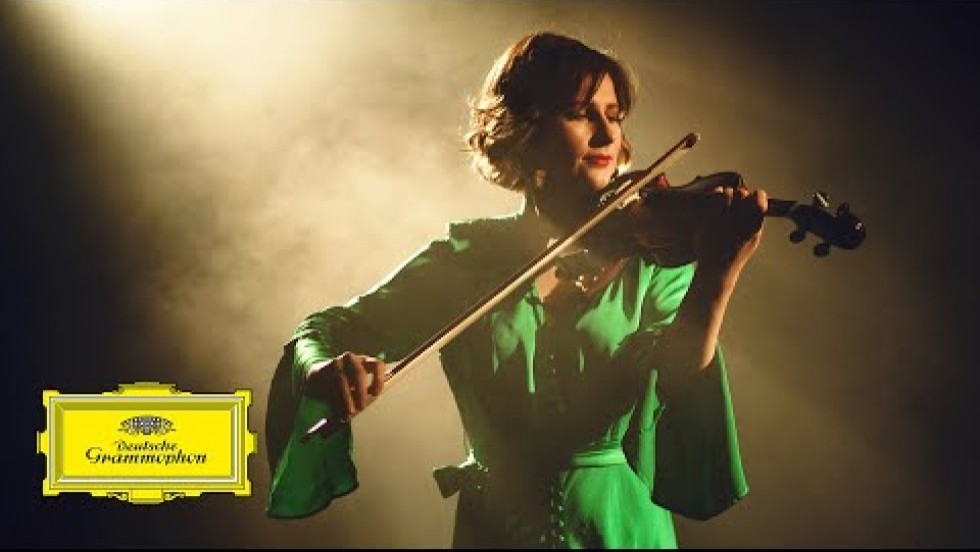
Legrand – Paris Violon
This performance is an Aaron Richmond Recital, named in honor of Vivo Performing Arts's founder, and endowed by his daughter Nancy Richmond Winsten and her late husband Dr. Joseph Winsten.
Mozart's Clarinet Concerto
Piano
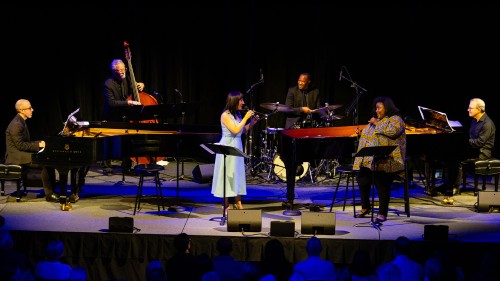
Anything But Standard: The Music of Ella Fitzgerald and Oscar Peterson