Nemanja Radulović & Double Sens
FRI NOV 13 8PM
NEC's Jordan Hall
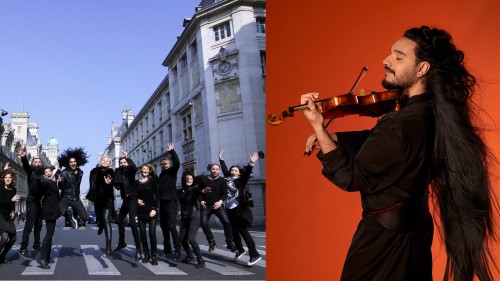
Serbian-born, Paris-based violinist Nemanja Radulović founded Double Sens as an artistic reflection of his dual identity—the creative dialogue between two cultures that shape his voice. He brought together a circle of trusted Serbian and French musicians, united by friendship and a shared desire to inspire one another toward their highest artistry.
Making its U.S. debut in 2026 with a program including Vivaldi's The Four Seasons, the ensemble moves seamlessly between classical masterworks, folk traditions, and repertoire beyond, performing with striking charisma, agility, and emotional depth. Double Sens radiates warmth, authenticity, and a palpable sense of freedom that captivates audiences from the very first note.
“An artist who has the ability to transcend the boundaries of classical music.”
Le Figaro
Program notes to come.
Symphonic Suite from Scheherazade, Op. 35 (arr. Aleksandar Sedlar)
Please note the following note covers the entirety of the work and today's performance will be a suite drawn from the work and arranged for chamber orchestra by Aleksandar Sedlar.
Rimsky-Korsakov came of age amid a rising tide of nationalism that was sweeping Europe. As a young man he fell in with a group of fellow Russian composers later nicknamed “The Five.” Also known as “The Mighty Handful,” this coterie of mid-nineteenth century composers advocated for Russian musical nationalism, though they also used their craft to depict the exotic.
Rimsky-Korsakov, the master orchestrator famous for the Russian Easter Festival Overture and the thrilling Capriccio espagnole, turned to the stories of the One Thousand and One Nights for his programmatic Scheherazade. Commonly known as the Arabian Nights, according to legend these stories are the collected tales of the princess Scheherazade, whose cruel husband, the sultan Schariar, notoriously murdered each of his brides after their wedding nights. Scheherazade cunningly avoids this fate by telling her husband a new story every evening. Each tale she leaves unfinished, leaving her husband no choice but to spare her so she could finish the previous night’s story. Eventually the sultan decides to spare Scheherazade’s life for good, and they remain happily married to the end of their days.
In his autobiography My Musical Life, Rimsky-Korsakov reflected on Scheherazade, stating that he “had in view the creation of an orchestral suite in four movements, closely knit by the community of its themes and motives, yet presenting, as it were, a kaleidoscope of fairy-tale images and designs of oriental character.” Looking back on its composition, the composer claimed that he had initially intended the piece to be more ambiguous, and that only at the insistence of one of his former students did he add titles to each movement. The ostensible leitmotifs in this work are rarely used to identify specific characters—unlike those of Richard Wagner—but are instead “nothing but purely musical material.” This thematic mutability does not extend to Scheherazade, whose theme Rimsky-Korsakov consistently scored for solo violin.
The first movement introduces the sultan with a belligerent brass fanfare, followed by the beguiling voice of Scheherazade. Triplet figures in this movement call to mind the nautical voyages (and frequent shipwrecks) of the sailor Sinbad. The third movement, titled “The Young Prince and the Young Princess,” tells of two genies in love with the titular nobility. The genies place the prince and princess in a contest to see which person finds the other more beautiful; in true fairy-tale fashion, they fall in love with one another and, after a series of misadventures and separations, live happily ever after. In the fourth and last movement, the themes of the first three movements are brought back, making for a rousing finale that ends in tranquility, like the last words of a bedtime story.
Rimsky-Korsakov wrote that his intention for the piece was to “direct but slightly the listener's fancy on the path which my own fancy had traveled, and to leave more minute and particular conceptions to the will and mood of the individual listener.” Whether or not we listen to this piece as highly programmatic or more generally as “Oriental…fairy-tale wonders,” the exotic timbres, lush harmonies, and chromatically inflected melodies make Scheherazade a thrilling part of the orchestral repertoire.
© Andrew McIntyre, 2026

Nemanja Radulović & Double Sens | Hommage à Aleksandar Šišić (Medley)
Nemanja Radulović and Double Sens: Bach Preview

Nemanja Radulović and Double Sens: Beethoven Preview


Mozart's Clarinet Concerto

Piano

Anything But Standard: The Music of Ella Fitzgerald and Oscar Peterson